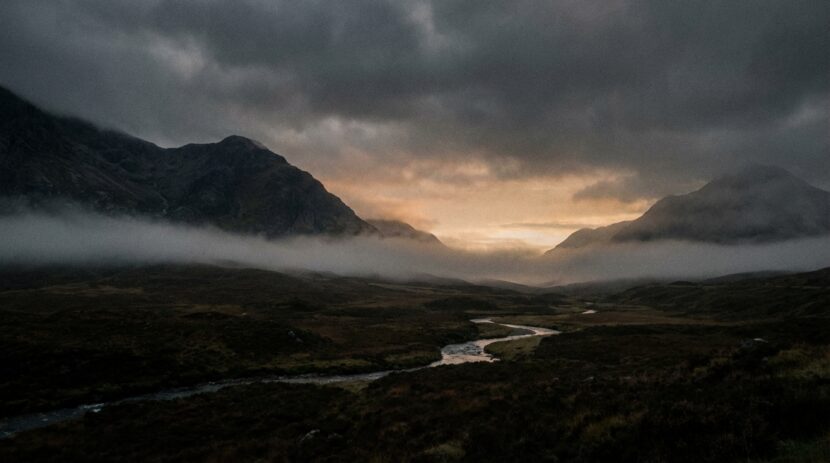
There is a particular kind of silence that only the Scottish Highlands can give you. It is not peaceful, exactly. It is older than that. It is the silence of mountains that have watched everything and said nothing, of lochs so still they look painted, of fog that moves through a glen like it has somewhere to be.
If you have been hunting for Scottish Highlands aesthetic photos that actually captures that feeling, the weight of the place, the way the light dies slowly and beautifully in the west, the drama of a storm breaking over a ridge, you are in exactly the right place.
This collection of 25 moody Scotland landscape photos was created as a practical guide for photographers who want to capture the Highlands at their most atmospheric. Every image in this collection came from a specific set of decisions: where to stand, when to arrive, what settings to use, and how to wait. Each scene breakdown below walks you through exactly how to recreate it.
All images provided are original and can be used as a reference for your own photos.
Table of Contents
Why the Scottish Highlands Are a Photographer’s Dream
The Scottish Highlands are one of the most photogenic landscapes on earth, and not because they are pretty. They are not always pretty. They are dramatic, unpredictable, and at times genuinely hostile. And that is precisely why they reward the photographer who shows up early, stays late, and learns to read the weather.
Dark moody Scottish Highlands aesthetic photos happens when the conditions align: a storm moving in from the west, the last light of the day catching one ridge while everything else goes dark, morning fog thick enough to swallow a stone circle whole. These moments are not rare in the Highlands. They happen regularly. The difference between photographers who capture them and those who miss them is almost always timing and patience, not equipment.
Understanding how light, colour, and mood interact is just as important for photographers as it is for painters. Our colour theory guide breaks down how the eye reads colour relationships, and that knowledge directly informs how you compose and expose a moody Highland shot. When you understand why the purple heather pops against a grey storm sky, you start anticipating those moments rather than reacting to them.
Camera Settings for Moody Highland Photography
Before you head into the field, it helps to understand the general settings approach that produces the dark, atmospheric, film-like quality you see in this collection. These are starting points, not rules.
Shoot in RAW
Always. Highland light is complex and unpredictable. You will need the latitude that RAW files give you to recover shadow detail, pull back blown highlights in a storm sky, and control the colour temperature of overcast scenes in post.
Expose to the Left
For moody, dark images, underexpose by half a stop to a full stop from what your meter suggests. Highland overcast scenes will often fool your camera into overexposing, lifting the darks and washing out that brooding atmosphere. Expose for the shadows you want to keep and let the sky do what it does.
Use a Low ISO in Good Light, Higher ISO in Low Light
The film-grain aesthetic these images carry is deliberate. When shooting in pre-dawn fog, late dusk, or the interior of a ruined cottage, push your ISO to 800 to 3200 and do not be afraid of the grain. It adds to the mood rather than fighting it. In reasonable light, ISO 100 to 400 keeps your images clean for any print applications.
Slow Your Shutter for Water and Mist
Long exposure work transforms Highland waterfalls, lochs, and coastal scenes. A shutter speed of two to thirty seconds will turn moving water into silk and smooth out loch reflections into glass. Bring a sturdy tripod. Highland ground is uneven and wind is constant.
Shoot Wide in Vast Landscapes, Longer in Wildlife and Intimate Scenes
A wide angle lens from 16mm to 24mm captures the overwhelming scale of Rannoch Moor or a Glencoe pass. For deer, Highland cattle in fog, and any scene where you want compressed perspective and separation from the background, step up to 70mm to 200mm.
For a deeper technical breakdown of shooting in extreme low-light and weather conditions, Digital Photography School’s guide to moody landscape photography is one of the most practical resources available. Their advice on histogram reading and graduated ND filter use is particularly relevant for Highland overcast shooting.
When to Go: Timing Your Highland Shoots
The golden hour in the Highlands is not always golden. In winter, the sun barely clears the ridgeline before beginning its descent, which means the entire day operates in a kind of extended blue hour. In autumn, the light has a quality of warmth and melancholy that is specific to the season. Summer gives you the longest days but also the flattest, most ordinary light. For moody Scotland landscape photos, autumn and winter are overwhelmingly the best seasons to visit.
- Dawn: Arrive before first light. The mist sits in the glens for the hour after sunrise. This window closes quickly.
- Late afternoon to dusk: The light drops fast. The last forty minutes before sunset are often the most dramatic of the day.
- After rain: The air is clean, the rocks are wet and dark, the puddles are perfect mirrors. Shoot immediately after a shower passes.
- During a storm: Counterintuitive but true. Storm light breaking through cloud cover produces chiaroscuro drama that no clear day can match.
- Blue hour: The twenty minutes after sunset when the sky becomes deep blue-grey and any remaining light on the water glows. One of the most underused shooting windows in Highland photography.
Planning Your Glencoe Shoot
Several images in this collection were captured in and around the Glencoe valley. Glencoe photography inspiration has drawn photographers for generations because the valley is a natural theatre. Dark walls of volcanic rock close in on either side. The sky overhead is enormous. The scale is overwhelming in a way that you feel in your chest before your eye composes a frame.
The best viewpoints in Glencoe for moody photography include the Study viewpoint for valley-wide compositions, the River Coe at low water for reflection shots, and the Meeting of Three Waters for dramatic cascades. For information on access, parking, and seasonal conditions, VisitScotland’s Glencoe guide is the most reliable and up-to-date resource. Understanding the geography of the valley before you arrive helps you predict where the light will fall at different times of day.
Plan for at least two full days in Glencoe if the weather is your primary variable. One day may be overcast and flat. The next may deliver exactly the storm light you came for.
25 Moody Scottish Highlands Scenes and How to Capture Them
Each scene below includes a description of what makes the shot work and a practical breakdown of how to position yourself, time your visit, and set up your camera to capture it. Use these as your field guide.
1. Misty Glen at First Light
Scottish Highlands aesthetic photography | Dawn | Fog | Long exposure
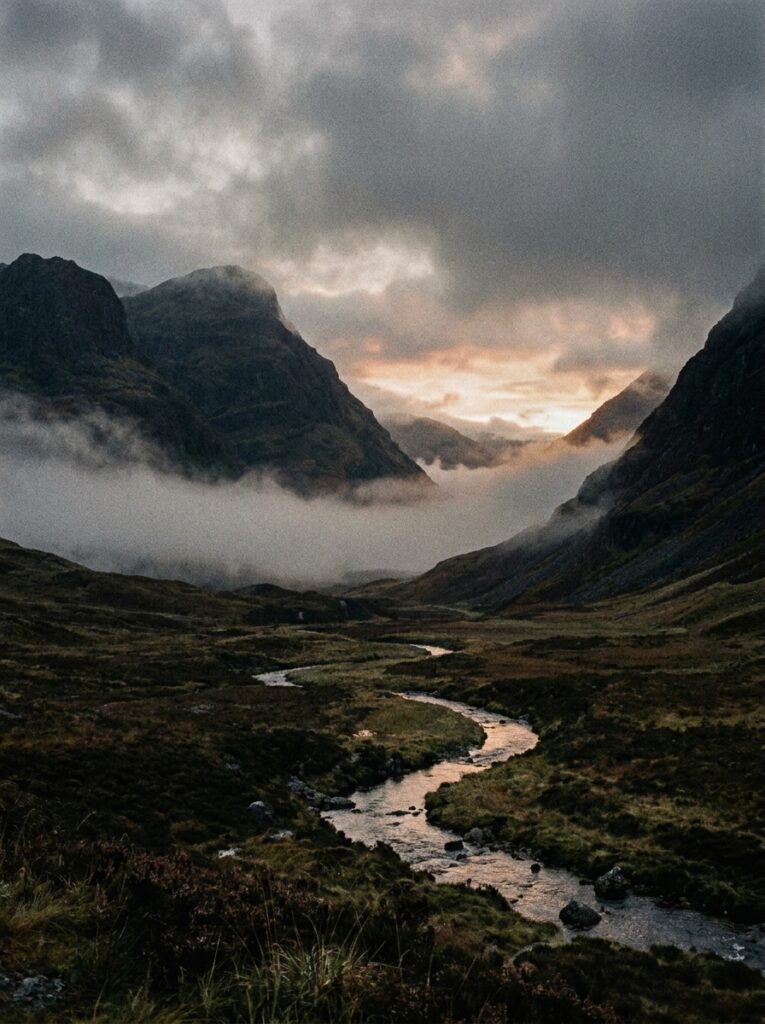
Misty Scottish Highland glen at first light, low rolling fog between dark mountain slopes, faint warm sunrise glow, heather-covered ground, narrow stream catching light
This shot lives or dies on timing. The window for low rolling fog sitting between dark mountain slopes is narrow, usually the forty minutes around and just after sunrise on a calm morning following overnight rain or a temperature drop. The fog burns off quickly once the sun climbs. Arrive in darkness, position yourself on high ground looking down into the glen, and wait.
How to Shoot It: Use a focal length between 50mm and 85mm to compress the distance between the fog layer and the mountain slopes behind it. Set your exposure for the faint warm glow on the horizon and let the fog read as bright. A two-second to eight-second exposure on a tripod will hold the fog as a smooth, even plane rather than showing individual wisps.
2. Lone Cottage on the Moor
Moody Scotland photos | Architecture | Isolation | Storm sky
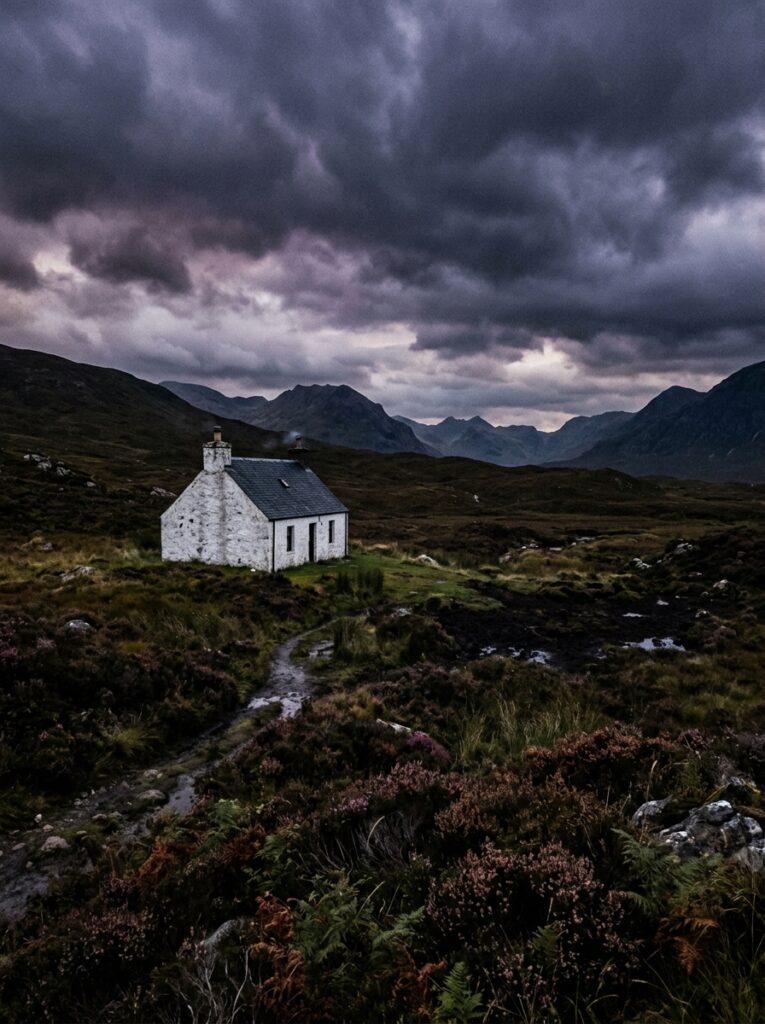
Lone whitewashed stone cottage on vast dark Scottish moorland, bruised purple and grey storm sky, surrounding heather and peat bog, late afternoon fading light
The power of this shot is the scale relationship between the small white cottage and the enormous, bruised storm sky above it. Finding the right cottage is step one: search the moorland areas of Rannoch, Sutherland, and the Flow Country for isolated whitewashed structures with no other buildings in frame. Step two is patience. You need the storm to arrive while there is still enough light on the cottage walls to make them read as white, not grey.
How to Shoot It: Position yourself low and give the sky two thirds of the frame. A wide angle lens from 16mm to 24mm exaggerates the sky and emphasises the isolation of the cottage. Expose for the sky. The cottage walls, being white, will hold their own light even at slight underexposure.
3. Stormy Loch Reflection
Dark moody Scotland scenery | Reflection | Loch | Storm
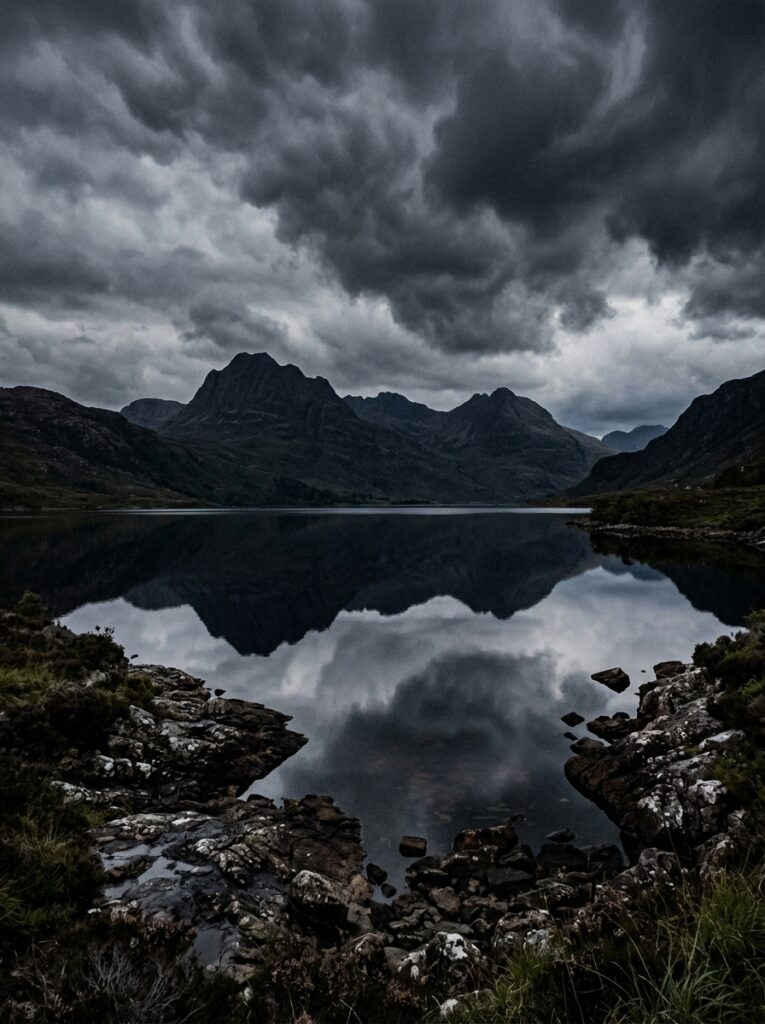
Stormy Scottish loch with perfect dark reflection of dramatic storm clouds and mountain silhouettes in still black water, grey and charcoal tones, late evening light
A perfect loch reflection requires two specific conditions simultaneously: dramatic cloud overhead and no wind on the water surface. This sounds contradictory, and it often is. The window when a storm is building but the wind has not yet reached the loch is sometimes only minutes long. Visit the loch in the hour before a forecast storm and check the water surface constantly. The moment you see the reflection go glassy, shoot.
How to Shoot It: A polarising filter cuts surface reflections on water in bright conditions, but here you want the reflection to read as darkly as possible. Skip the polariser. Set your composition so the horizon sits exactly at the midpoint of the frame, or deliberately low to give more weight to the reflective water below.
4. Ancient Stone Circle in Fog
Scottish Highlands art reference photos | Standing stones | Fog | Mystery
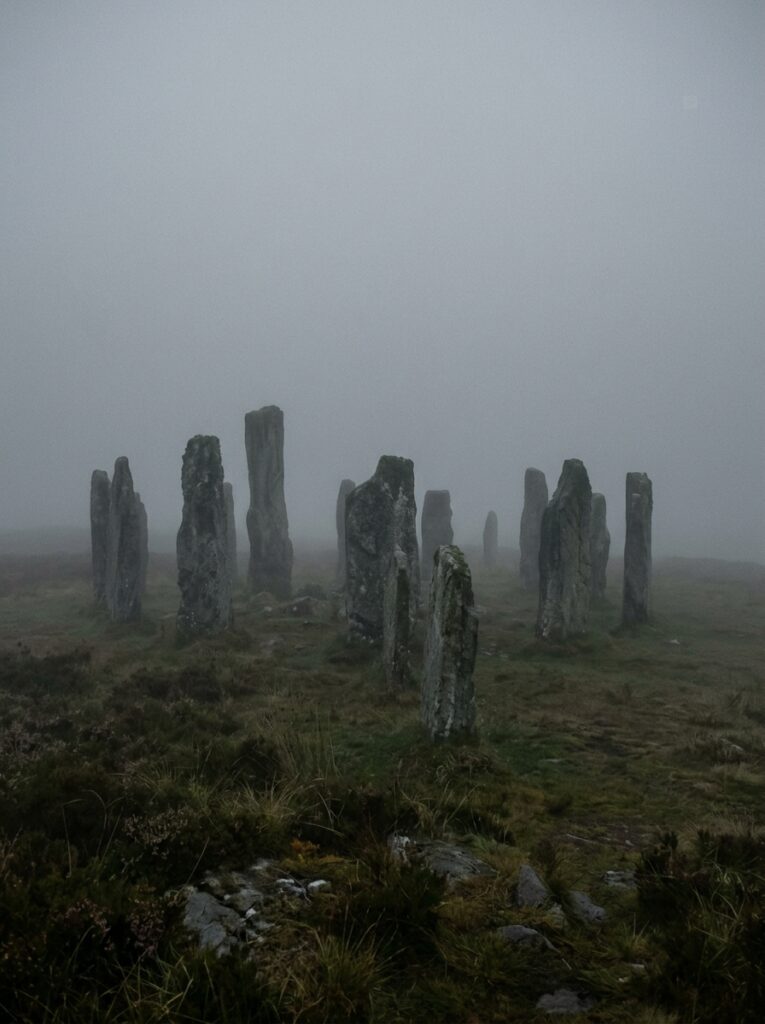
Ancient Scottish standing stone circle partially emerging from thick morning fog, grey weathered stones of varying heights, dense low mist obscuring stone bases, flat diffused grey light
Scotland’s standing stones are most frequently found on open moorland and hill slopes, which makes them ideal candidates for early morning fog photography. The Callanish Stones on the Isle of Lewis and the Ring of Brodgar in Orkney are the most iconic. For access information and visiting conditions, Historic Environment Scotland maintains detailed records for all scheduled monuments. Arrive in the hour before sunrise and position yourself among or just outside the circle. The mist must be thick enough to obscure the base of the stones but not so dense that the stones themselves disappear.
How to Shoot It: Use a longer focal length, around 70mm to 100mm, to stack the stones against each other and create that sense of crowding emergence from the mist. Flat, diffused grey light is actually ideal here. Avoid sunny days entirely for this shot.
5. Single Figure on a Ridge
Scottish Highlands aesthetic photography | Scale | Silhouette | Human element
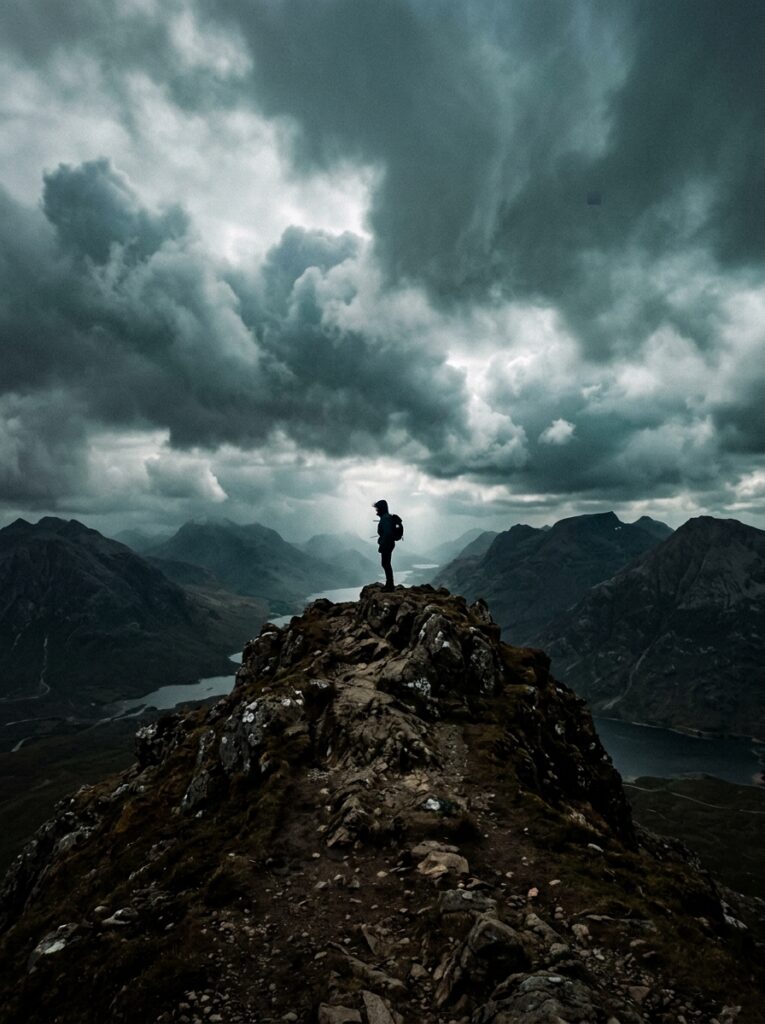
Tiny solitary human silhouette standing on high rocky Highland ridge against vast dramatic cloudy sky, figure extremely small against massive landscape scale, grey and dark teal tones
The figure in this shot exists to communicate scale, not identity. Everything depends on keeping the person small, just a dark mark against a vast, clouded sky. Ask your subject to stand still and not to pose. The stillness is what gives the image its emotional weight. Choose a ridge with a clean skyline, no background clutter visible behind the silhouette.
How to Shoot It: Position yourself below and some distance back from your subject so they appear small against the sky. A 50mm to 85mm focal length works well. Expose for the bright sky above and let the figure go to near-complete silhouette. Any detail in the figure reduces the emotional impact significantly.
6. Autumn Bracken Hillside
Moody Scotland landscape photos | Autumn | Texture | Colour
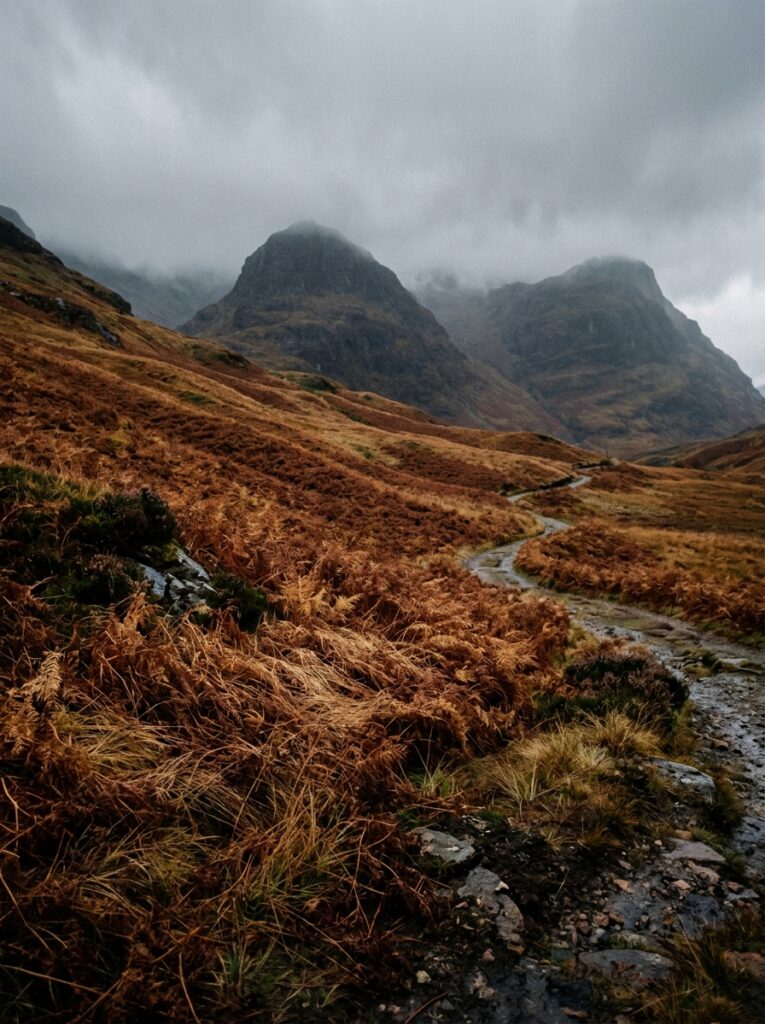
Scottish Highland hillside covered in dying autumn bracken, deep rust burnt orange and faded gold tones against flat grey overcast sky, rolling textured hillside, wet ground
The bracken turns in October and early November across most Highland hillsides. The key to this shot is the overcast sky: it acts as a giant softbox, removing harsh shadows and allowing the earthy rust and gold tones of the dying bracken to saturate without blowing out. Shoot on flat, overcast days rather than in direct sunlight. The texture of the hillside, all that layered, rolling bracken, is the subject.
How to Shoot It: Position yourself so the hillside fills the lower two thirds of the frame with the flat grey sky above. Use a polarising filter to deepen the saturation of the bracken even on overcast days. Shoot at f/8 to f/11 to keep the entire rolling hillside in focus from foreground to horizon.
7. Rain Sweeping Across the Glen
Dark moody Scotland scenery | Weather | Rain | Atmosphere
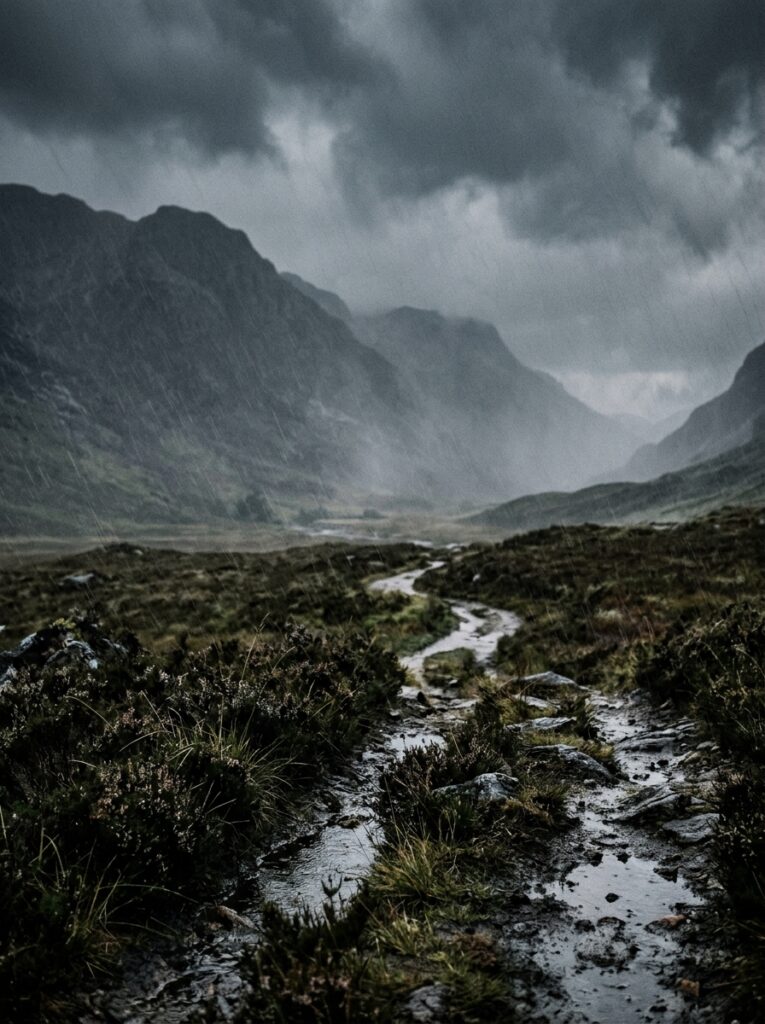
Diagonal rain sweeping across Scottish Highland glen, visible rain curtain blurring distant mountains into soft grey shapes, sharp wet heather in foreground, dark brooding sky, puddles on moorland path
Rain curtains, the visible diagonal sweep of heavy rain moving across a valley, are most common during Atlantic weather systems moving in from the west. Watch the forecast for strong westerly winds with heavy showers and position yourself looking east or northeast into the glen so the rain is moving across your field of view rather than directly at you. You will need a fast shutter speed to freeze the diagonal rain pattern.
How to Shoot It: Set your shutter to at least 1/500s to capture individual rain streaks in the foreground while the distant mountains blur naturally through the rain curtain. A dark, wet piece of heather in sharp foreground focus anchors the composition. Weather sealing on your camera body is strongly recommended for this shot.
8. Ruined Castle by the Water
Scottish Highlands art reference photos | Architecture | History | Reflection
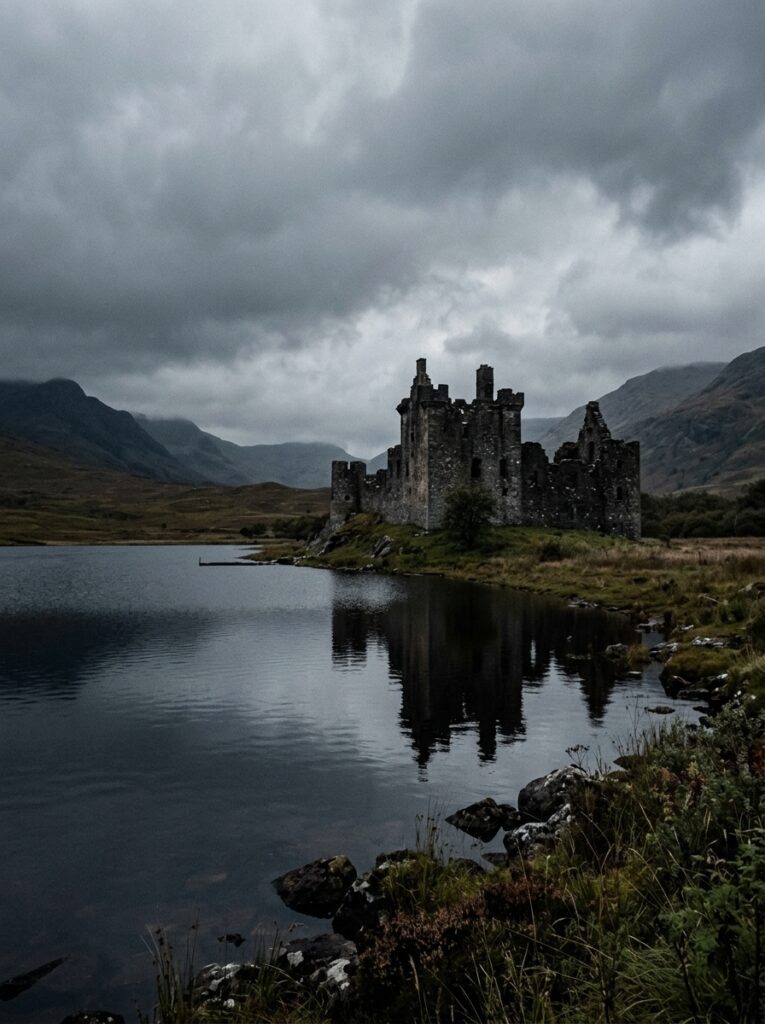
Ruined Scottish castle with broken roofless stone walls at edge of dark loch, reflection visible in still water, overcast grey sky, surrounding moorland, late afternoon fading light
Castle Tioram on Loch Moidart and Kilchurn Castle on Loch Awe are two of the most photographable Highland ruins for this type of shot. The composition depends on still water for the reflection and overcast, even light that brings out the texture of the stone without creating harsh shadows in the window openings. Late afternoon gives you the warmest quality of grey light available.
How to Shoot It: A focal length of 35mm to 50mm gives a natural perspective on the ruin and its relationship to the loch. Position yourself so the waterline sits in the lower third of the frame. If the water is perfectly still, allow equal space for the reflection as for the structure above. A two-second exposure on a tripod smooths out any small surface ripples.
9. Twisted Hawthorn Tree on Clifftop
Moody Scotland photos | Tree | Wind | Coastal
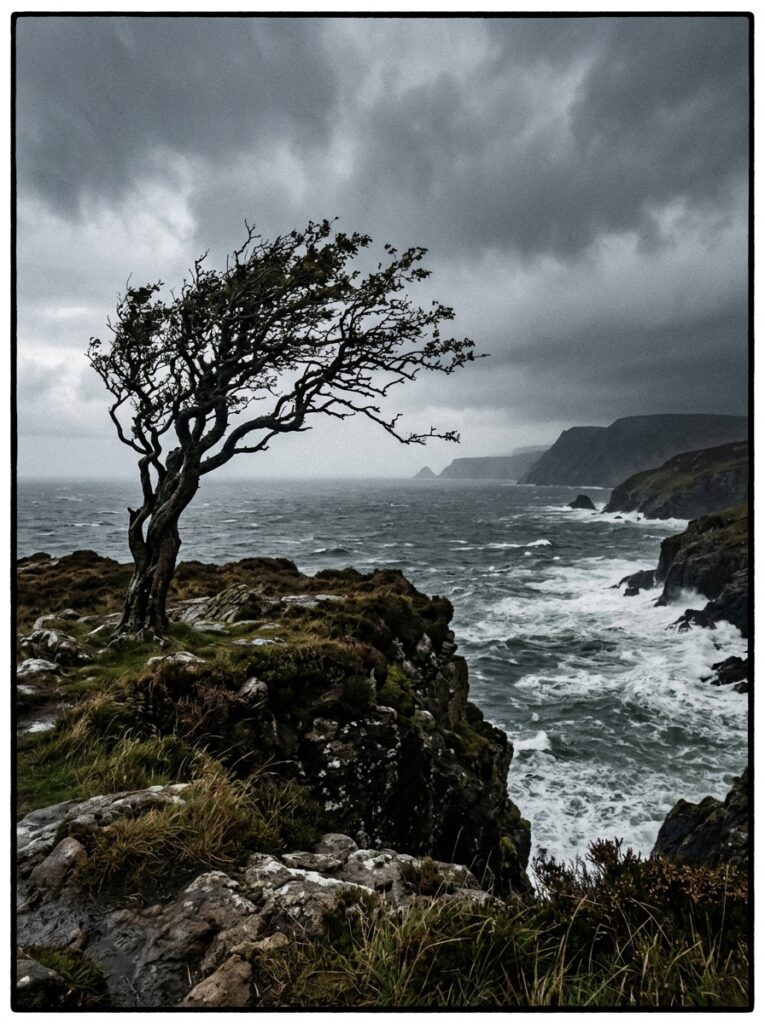
Single ancient wind-twisted hawthorn tree on Scottish clifftop, permanently bent sideways by prevailing wind, stormy grey sea and sky beyond, rocky cliff edge, overcast flat light
Wind-sculpted hawthorn trees are found along exposed coastal clifftops throughout the western Highlands and the Hebridean islands. The Ardnamurchan peninsula and the Kintyre coast are particularly good hunting grounds. The best examples have spent decades in the prevailing westerly wind and lean at dramatic angles that tell the whole story of the place without any other element in the frame.
How to Shoot It: Shoot into the light or with overcast sky behind the tree so it reads as a strong silhouette or near-silhouette. Get low and position the twisted crown of the tree against the widest expanse of sky. Avoid shooting with hedges, fences, or other trees visible in the frame. Isolation is everything here.
10. Waterfall Through Dark Woodland
Scottish Highlands aesthetic photography | Waterfall | Long exposure | Forest
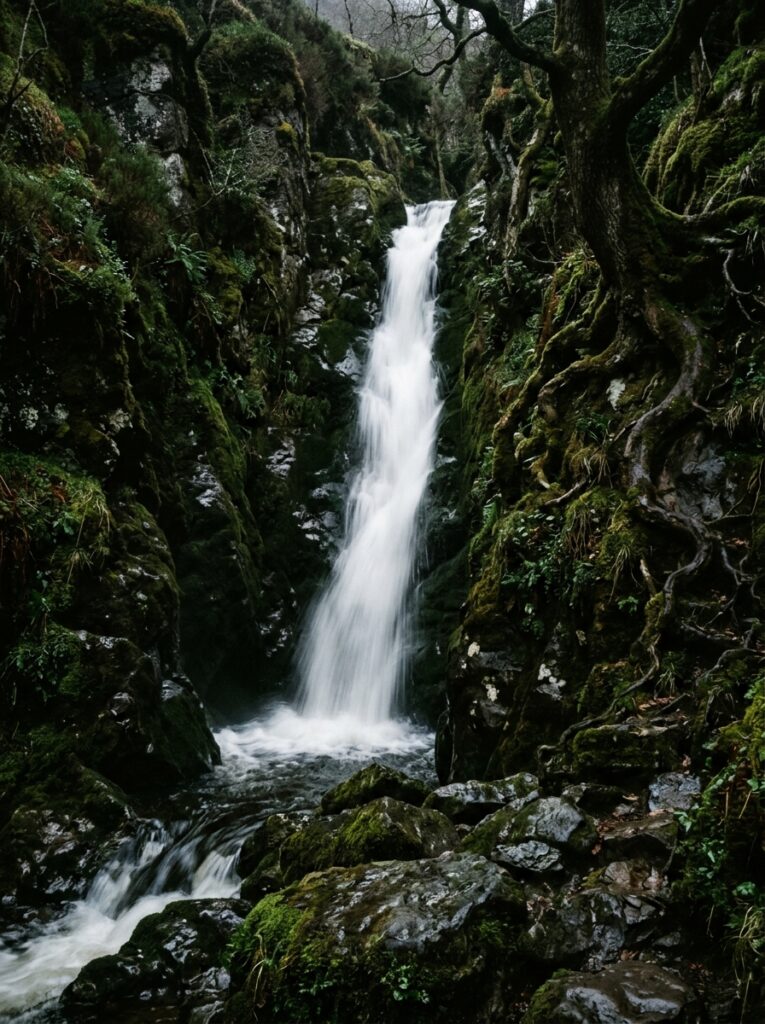
White Highland waterfall cascading through narrow dark gorge, ancient moss-covered rocks and twisted oak roots, deep shadow with white water as only light source, long exposure blur on water
The gorge waterfalls of the Highland oak woodlands, particularly around the Loch Lomond and Trossachs National Park, Glen Affric, and the Falls of Falloch, are best photographed in the soft, diffused light of an overcast day. Direct sunlight creates harsh contrast between the white water and the dark gorge walls that is very difficult to expose for. An overcast day gives you the full tonal range without blowing the highlights.
How to Shoot It: Use a shutter speed of between two and fifteen seconds to blur the waterfall into a smooth, luminous flow. A tripod is essential. Set your aperture to f/11 or narrower to keep the moss-covered rocks and oak roots in focus throughout. An ND filter will help you achieve longer exposures in brighter conditions.
11. Deer on the Morning Hillside
Moody Scotland photos | Wildlife | Red deer | Dawn
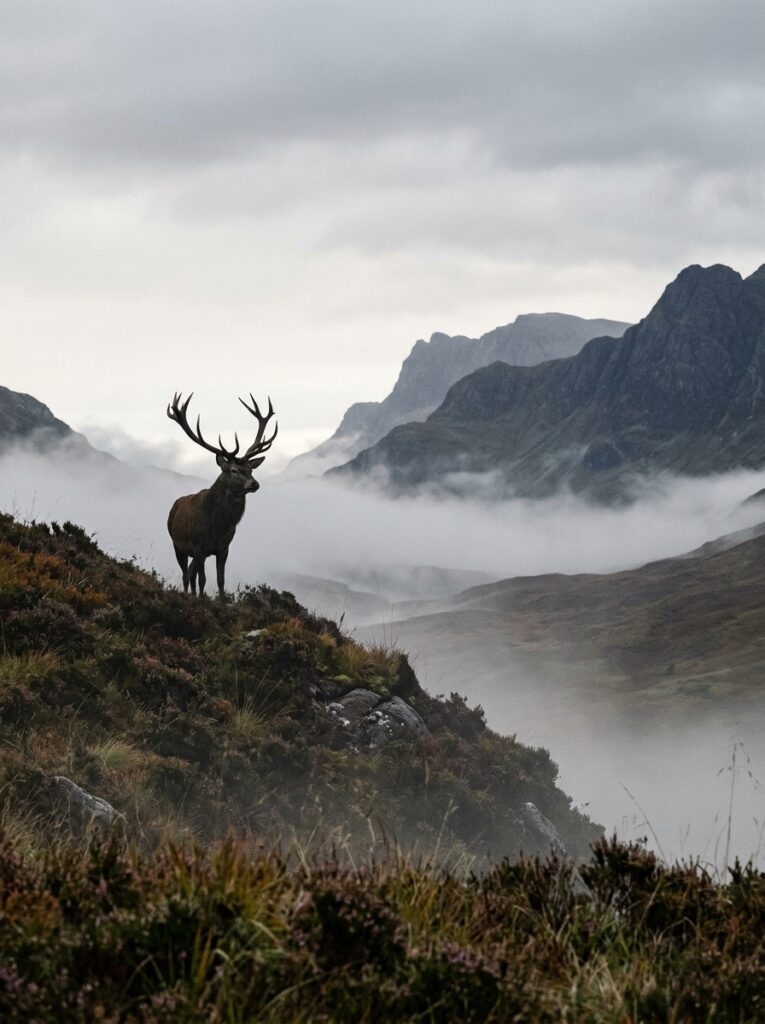
Lone red deer stag standing still on misty Scottish Highland hillside, large antlers silhouetted against pale grey morning light, surrounding heather and low fog, distant mountains behind
Red deer are most active at dawn and dusk, and stags are most visible and most photogenic during the autumn rut in October. Estates throughout the Cairngorms, Torridon, and the Ardgour peninsula have high deer populations. Approach slowly, from downwind, and use a long lens to observe the animal from a distance that does not disturb it. The stillness in this shot comes directly from not pushing too close.
How to Shoot It: A 300mm to 500mm focal length is ideal for compressing the background hillside behind the stag and achieving the separation between animal and landscape that makes this composition work. Shoot from the same level as the deer if possible, not from above. Eye-level wildlife photography always reads as more intimate and powerful.
12. Road Disappearing into Mist
Dark moody Scotland scenery | Road | Leading line | Mist
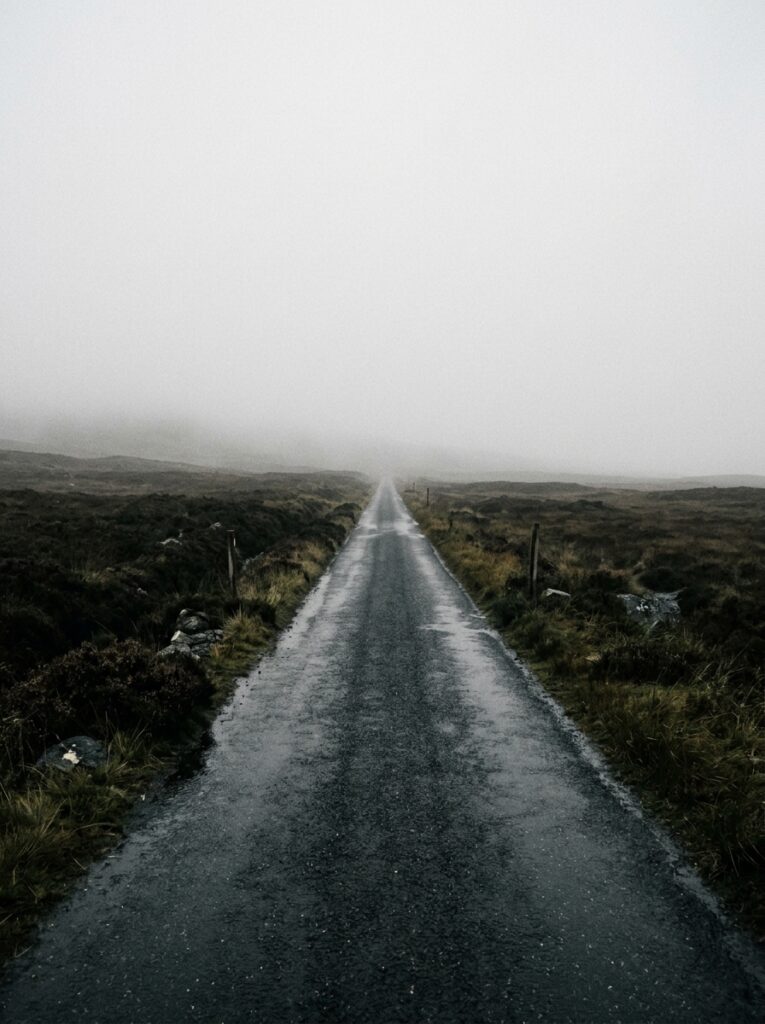
Narrow single-track Scottish Highland road stretching straight into dense wall of white mist, dark heather moorland on either side, no destination visible, wet tarmac reflecting grey sky
The single-track roads of the A82 corridor, the Applecross peninsula, and the Kintail area regularly disappear into morning mist during autumn and early winter. The key element here is the wet tarmac, which reflects the grey sky and creates a natural leading line into the mist. Shoot from road level, as low as safely possible, to maximise that reflective quality and emphasise the convergence of the road into the white wall ahead.
How to Shoot It: A wide angle lens from 16mm to 24mm exaggerates the vanishing point perspective and emphasises how completely the road disappears. Shoot at f/8 for front-to-back sharpness. Position yourself in the centre of the road only when it is clear and safe to do so. The most powerful version of this image has no curves in the road at all.
13. Storm Light on Ben Nevis
Scottish Highlands aesthetic photography | Ben Nevis | Storm light | Drama
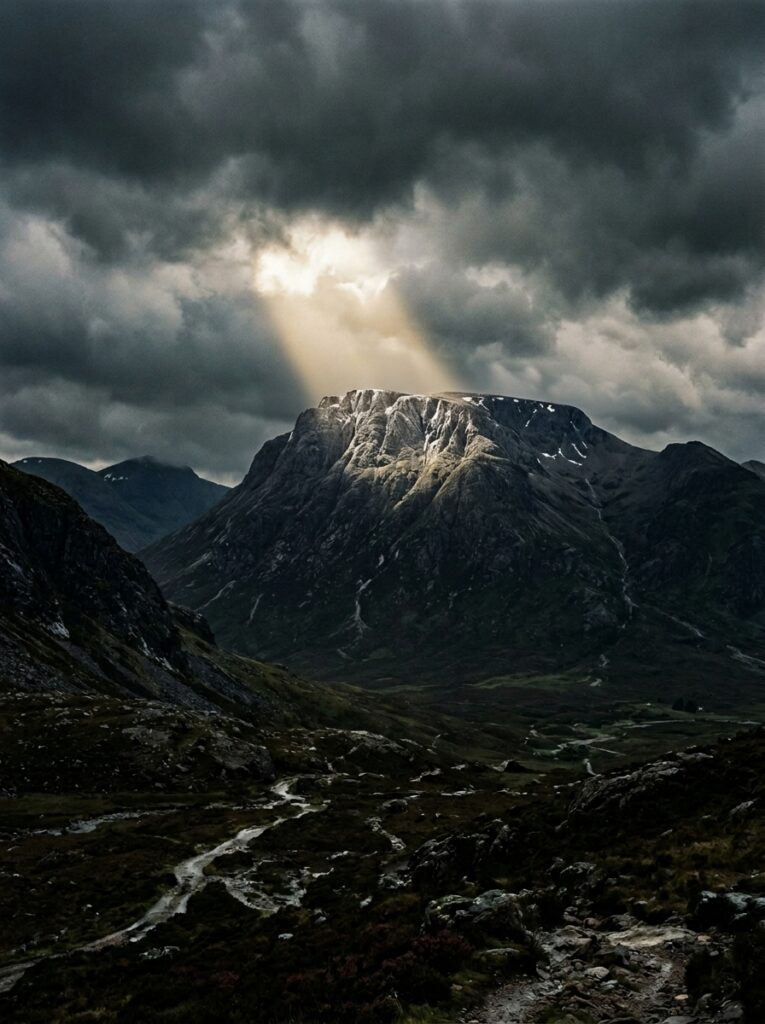
Dramatic storm light breaking through dark clouds onto Ben Nevis summit, single shaft of pale gold light illuminating peak while surrounding landscape remains dark and stormy, chiaroscuro lighting
Storm light on Ben Nevis is best observed from the eastern slopes above Roy Bridge or from the Aonach Mor access road to the north. The shaft-of-light effect requires a specific atmospheric condition: thick cloud cover with a gap at the western or southwestern horizon through which the sun breaks just before setting. This happens most commonly in the hour before a front arrives from the Atlantic or in the clearing behind a passing storm.
How to Shoot It: The exposure challenge here is significant. The illuminated summit may be three or four stops brighter than the surrounding dark landscape. Expose for the lit peak and let the surrounding mountains go dark. The drama depends on that contrast being stark and honest. A graduated ND filter positioned across the mid-frame helps balance the sky with the dark foreground landscape.
14. Abandoned Crofter’s Cottage Interior
Scottish Highlands art reference photos | Ruin | Interior | Available light
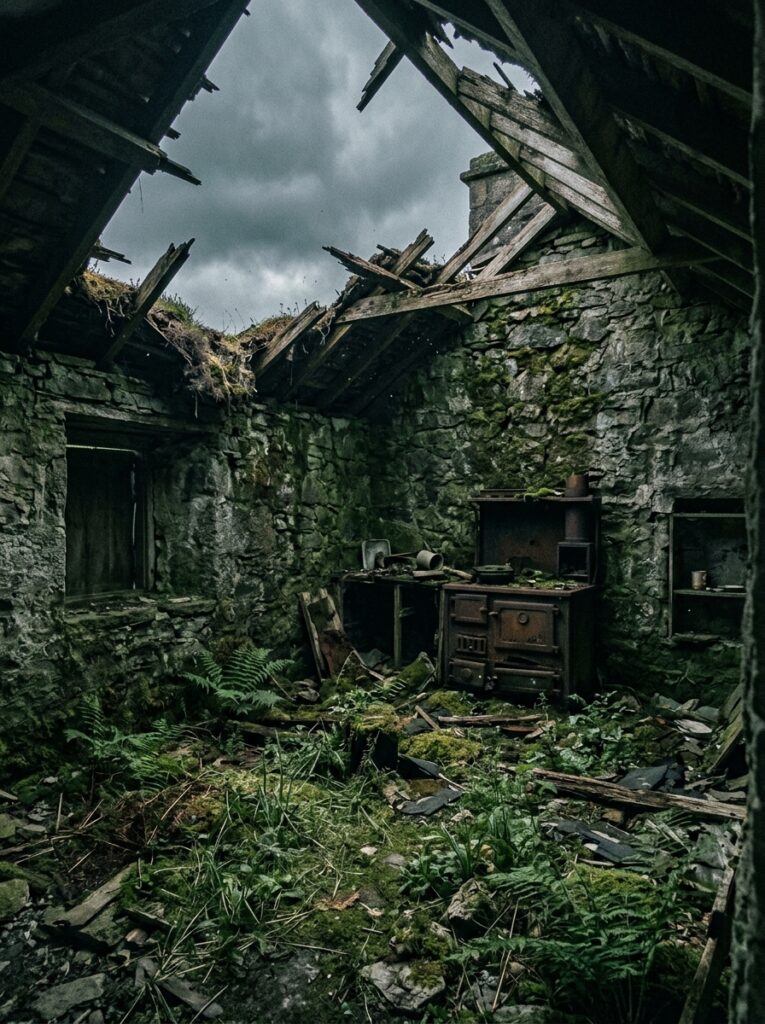
Abandoned Scottish crofter’s cottage interior, collapsed roof open to grey overcast sky, moss covered stone walls, rusted cast iron range in corner, overgrown floor, soft diffused natural light from above
Abandoned crofting settlements, or townships, are found throughout the western Highlands and Hebridean islands, particularly in areas cleared during the Highland Clearances of the 18th and 19th centuries. Many remain on open access land. The light inside a roofless ruin is some of the most beautiful available light in photography: completely diffused, coming from directly above, with no harsh shadows. It is most even on a flat overcast day.
How to Shoot It: Use a wide angle lens to capture both the interior detail and the sky above through the open roof in a single frame. A shutter speed of between half a second and four seconds on a tripod handles the low light without pushing the ISO unnecessarily. Focus on a strong foreground element, the cast iron range, a moss-covered stone, a rusted hinge, and let the sky frame itself above.
15. Purple Heather Under Storm Sky
Moody Scotland photos | Heather | Colour contrast | Moorland
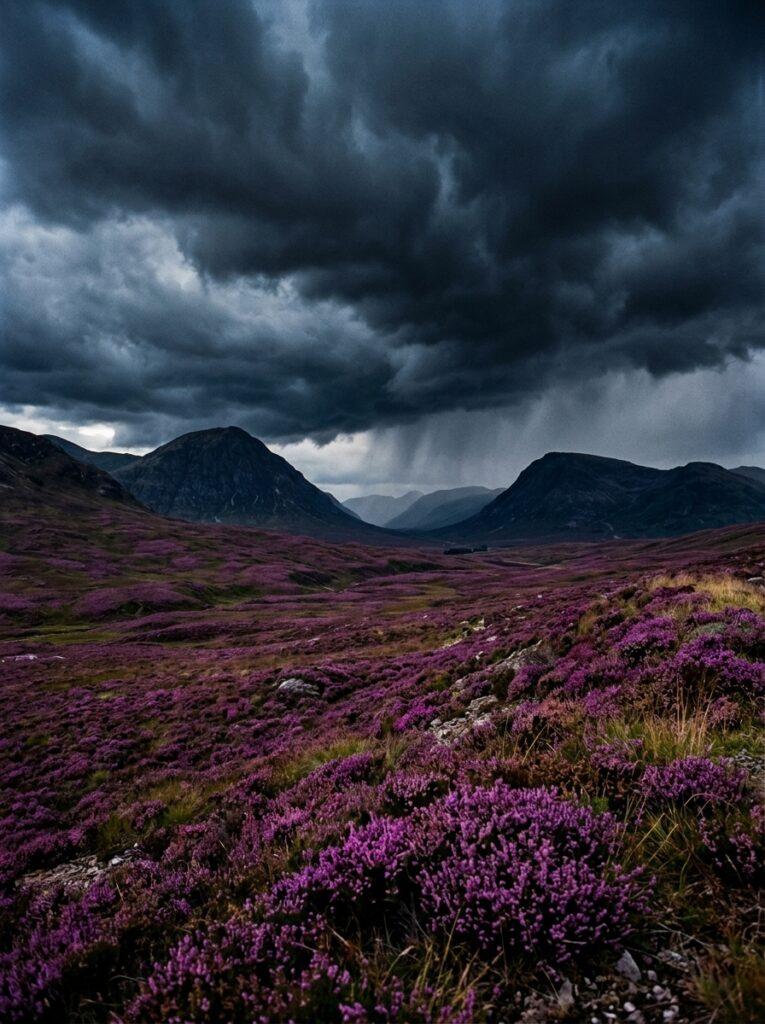
Vast Scottish Highland moorland covered in full bloom purple heather, extremely dark dramatic storm sky above creating violent colour contrast, rolling hills to horizon, no trees
Heather blooms across Highland moorland from late July through September, peaking in August. The colour contrast this image depends on requires the darkest possible storm sky overhead while the heather itself retains full saturation. This means shooting in the minutes before a heavy shower arrives, when the clouds have darkened maximally but the rain has not yet started. The window is sometimes less than ten minutes.
How to Shoot It: A polarising filter deepens the sky and boosts the heather saturation simultaneously. This is one of the few Highland shots where a polariser genuinely transforms the image. Set your horizon at or below the midpoint of the frame to give the heather more visual weight. Shoot at f/11 to keep the rolling moorland sharp from foreground to horizon.
16. Fishing Boat in Hebridean Harbour
Dark moody Scotland scenery | Coastal | Maritime | Dusk
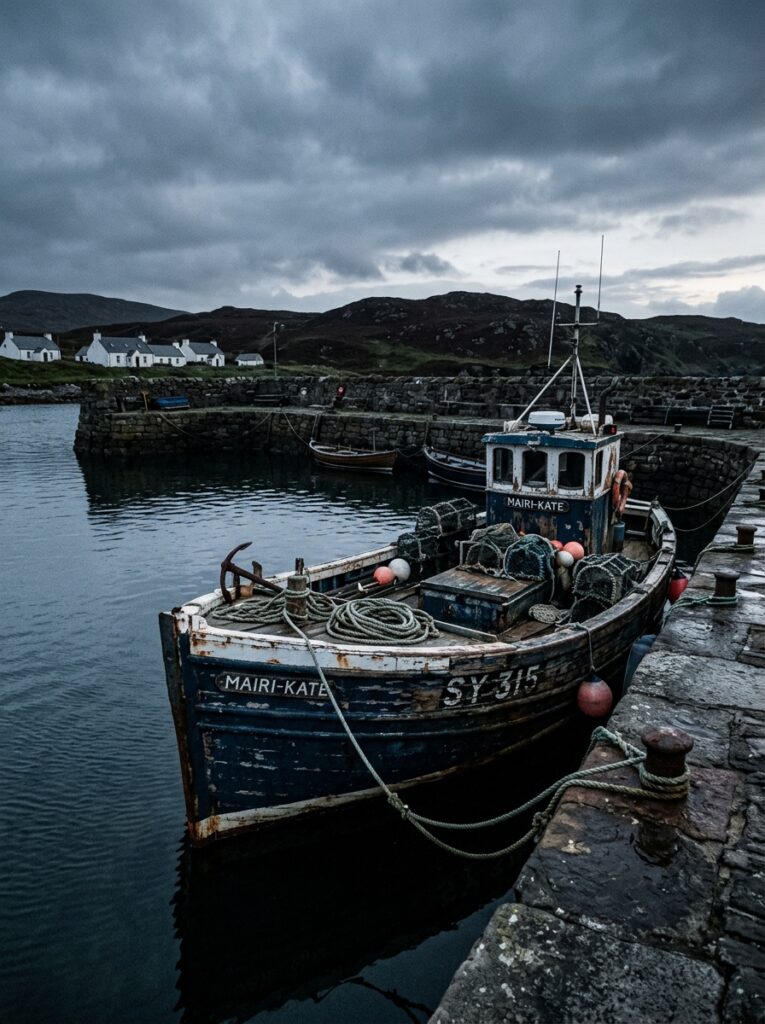
Weathered wooden fishing boat in small Scottish Hebridean harbour at dusk, peeling paint hull, coiled ropes on deck, still dark water, overcast fading evening light, old stone harbour wall
The small working harbours of the Outer Hebrides, particularly Leverburgh on Harris and Castlebay on Barra, are home to exactly the kind of weathered, character-filled fishing boats that make this image work. The key detail here is the quality of the boat: peeling paint, coiled rope, worn timber, visible rust. The harbour wall behind acts as a simple, neutral backdrop. Shoot at dusk when the ambient light is low and even and the water surface is at its darkest.
How to Shoot It: A focal length of 35mm to 50mm gives a natural, unforced perspective on the boat and its immediate environment. Position yourself at the same level as the boat’s gunwale rather than shooting down from the quay. Set your ISO to 800 to 1600 for the low dusk light. A shutter speed of one to four seconds smooths the water to a dark, glassy surface.
17. Morning Mist Over River Tay
Scottish Highlands aesthetic photography | River | Mist | Minimalist
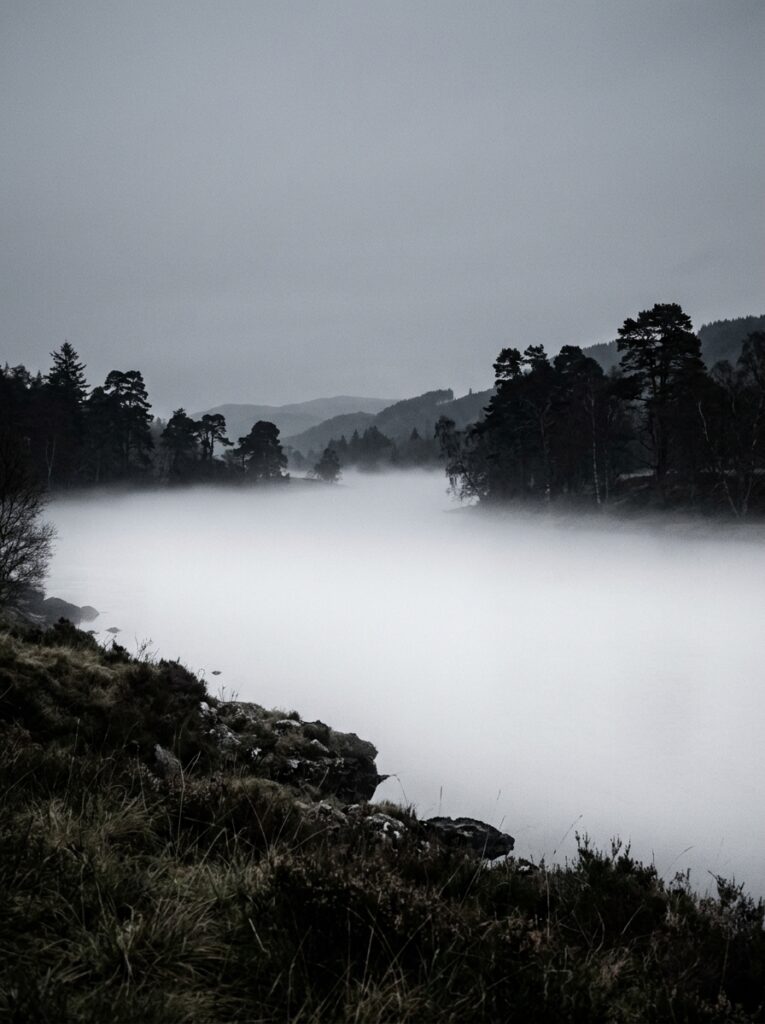
Scottish River Tay at dawn completely blanketed by low white morning mist, dark tree silhouettes emerging above mist line, flat grey pre-dawn light, mirror-still water surface invisible below mist
The River Tay between Aberfeldy and Dunkeld is particularly prone to a dense, complete fog blanket in calm autumn mornings that fills the entire valley floor and leaves only the tree canopies emerging above the mist line. Reach the river in complete darkness and position yourself on slightly elevated ground looking across the valley before first light. The mist dissipates as the temperature rises, so the best window is the twenty minutes either side of sunrise.
How to Shoot It: This composition works at its best as a clean horizontal composition: dark tree silhouettes in the upper third, white mist in the middle, and nothing below. A 50mm focal length produces a natural, undistorted horizon. Keep your exposure slightly conservative to hold the mist as bright white rather than lifting it to grey.
18. Glencoe Pass in Winter
Glencoe photography inspiration | Winter | Snow | Mountain pass
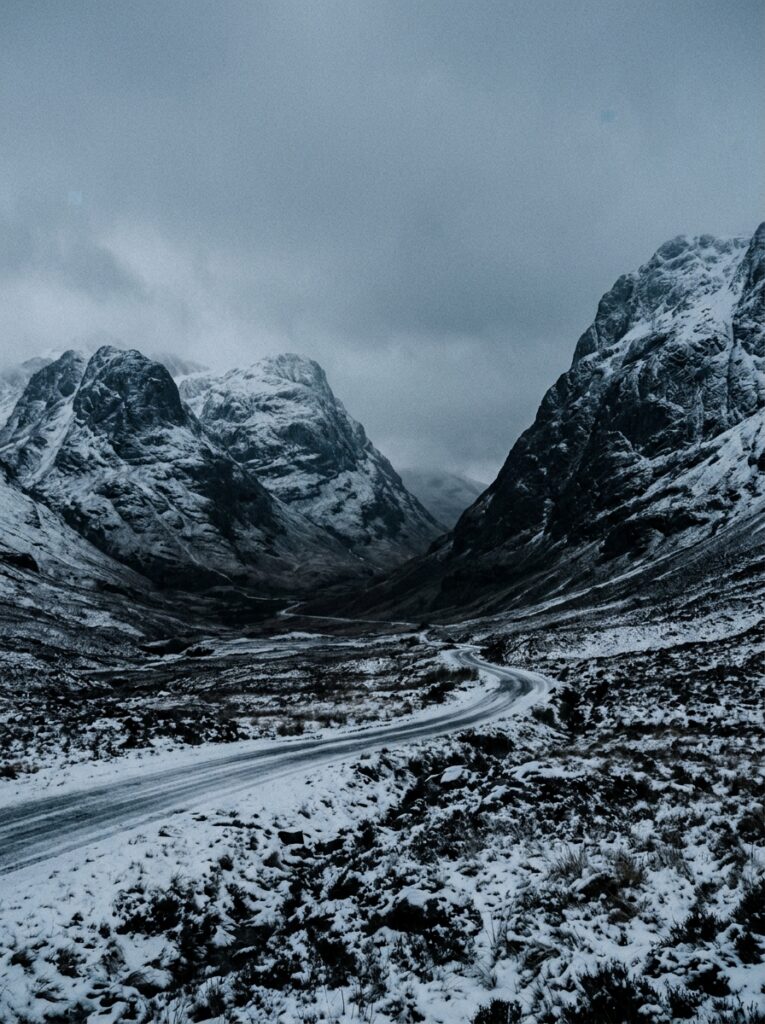
Glencoe mountain pass in winter, snow-dusted dark mountain peaks closing in on either side of narrow valley floor, flat cold grey winter light, dusting of snow on heather, no vegetation visible
Glencoe in winter is a completely different landscape from its summer version. The vegetation retreats, the rock is exposed, and the scale of the valley walls becomes overwhelming without the softening effect of bracken and heather. A light dusting of snow on the dark peaks is more visually powerful than a full snowfield because the darkness of the rock still reads through. Head to the valley floor on the A82 and look east toward the Buachaille Etive Mor for the classic winter composition.
How to Shoot It: Shoot in the flat, directionless grey light of a winter overcast day rather than waiting for sunshine. The cold, desaturated palette of this image depends on the absence of warm light. Set your white balance manually to daylight or slightly cool to prevent your camera from adding warmth that does not belong. A focal length of 24mm to 35mm captures the valley walls closing in on either side.
19. Tidal Pools at Low Tide
Moody Scotland landscape photos | Coastal | Tidal pools | Detail
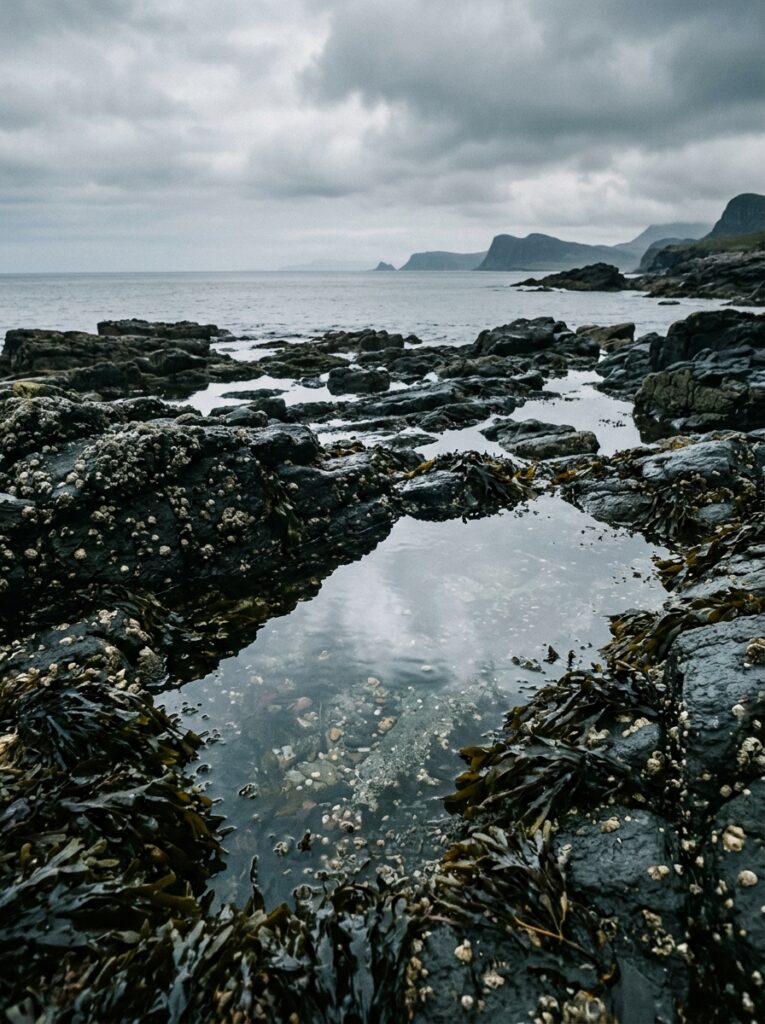
Scottish west coast rock pools at low tide, dark barnacle-covered rocks with clear shallow tidal pools reflecting overcast grey sky, wet seaweed, distant grey sea, flat diffused coastal light
The tidal pools of the Kintyre coast, the Ardnamurchan peninsula, and the western Hebridean shorelines are exposed for two to three hours around each low tide. Check the tide tables before you go. The best light for this shot is flat, overcast daylight, which allows the shallow pool reflections of the grey sky above to read clearly without surface glare. Shoot within an hour of low tide when the rocks are at their most exposed and the pools are at their clearest.
How to Shoot It: Get down to pool level and shoot almost horizontally across the water surface to capture the sky reflection in the pool. A wide angle lens from 16mm to 24mm used close to the foreground rock creates strong depth and allows a distant sea horizon in the upper frame. Protect your lens from spray with a lens cloth nearby.
20. Highland Cattle in Morning Fog
Scottish Highlands aesthetic photography | Wildlife | Highland cow | Fog
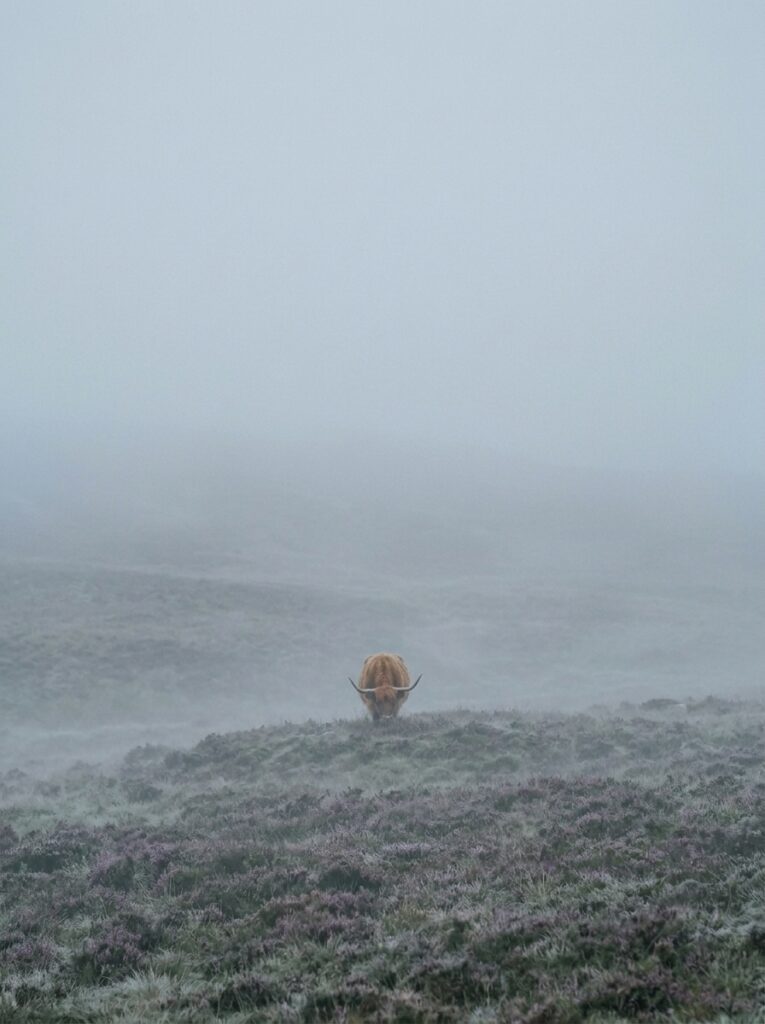
Highland cow with long thick russet shaggy coat and wide curved horns emerging from dense morning fog, face in sharp focus, fog obscuring body and background, warm russet against cool grey fog
Highland cattle are found on working farms and crofts throughout the region. They are generally calm and approachable but should not be crowded. The fog that makes this image extraordinary, thick enough to obscure the body and background while leaving the face visible, requires an early morning visit on a calm autumn or winter day. The Glencoe and Lochaber areas regularly produce this kind of dense, localised fog. Position yourself at the same height as the animal’s face rather than shooting down.
How to Shoot It: A 100mm to 200mm focal length compresses the fog behind the animal and creates the tight, face-forward composition this shot depends on. Focus precisely on the eyes and use the widest aperture your lens allows at that distance, around f/2.8 to f/5.6, to keep the background fog completely soft. The warm russet coat against the cool grey fog is the whole image. Expose to hold the coat detail.
21. Sunset Through Glen Trees
Dark moody Scotland scenery | Trees | Winter | Silver light
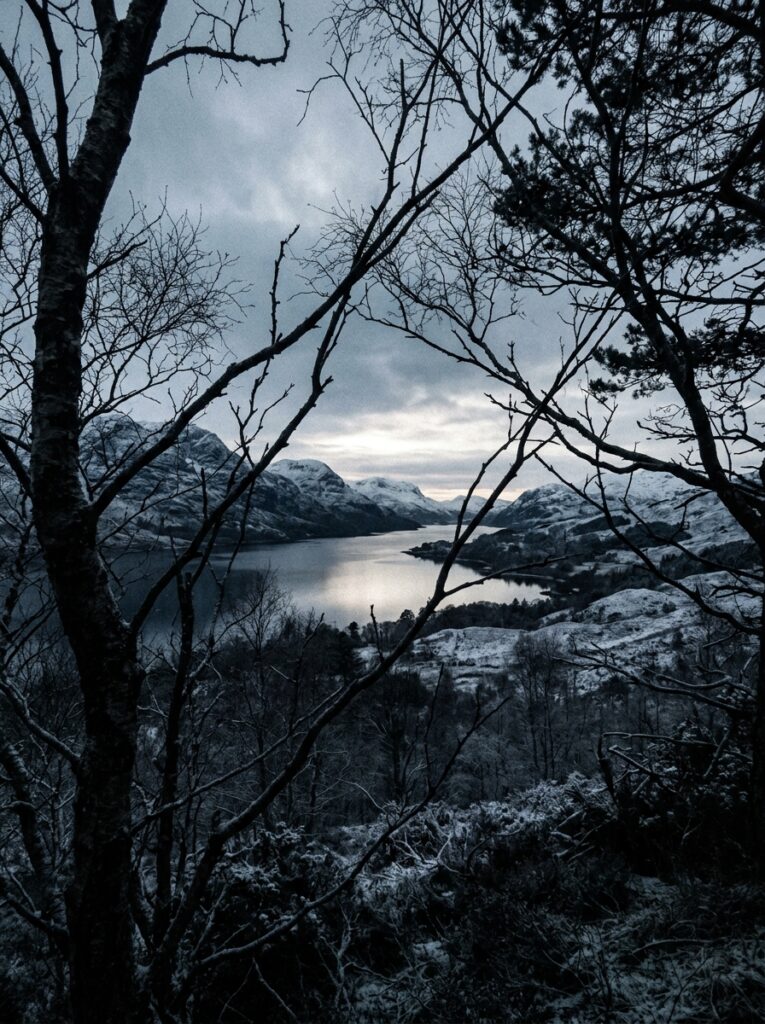
Cold pale Highland winter sunset seen through bare dark tree branches, faint silver light on distant loch surface beyond trees, dark silhouetted branches in foreground, no warm tones, flat cold light
This image works specifically because it refuses warmth. A Highland winter sunset seen through bare trees is not golden. It is silver and steel-grey, and the loch glimpsed beyond the branches holds whatever pale light the sky is willing to give. Find a position among birch or oak trees on the western shore of any Highland loch, with the water and the western horizon visible through the gap in the branches. Shoot in the fifteen minutes after the sun has set rather than during.
How to Shoot It: A focal length of 50mm to 85mm allows you to select exactly which gap in the branches frames the pale loch beyond. Use the silhouetted branches as graphic foreground framing rather than trying to expose for detail within them. Set your white balance to 4000K or manually cool to prevent any warmth creeping into what should be a cold, silver-grey image.
22. Rannoch Moor Vastness
Scottish Highlands aesthetic photography | Rannoch Moor | Vast | Empty
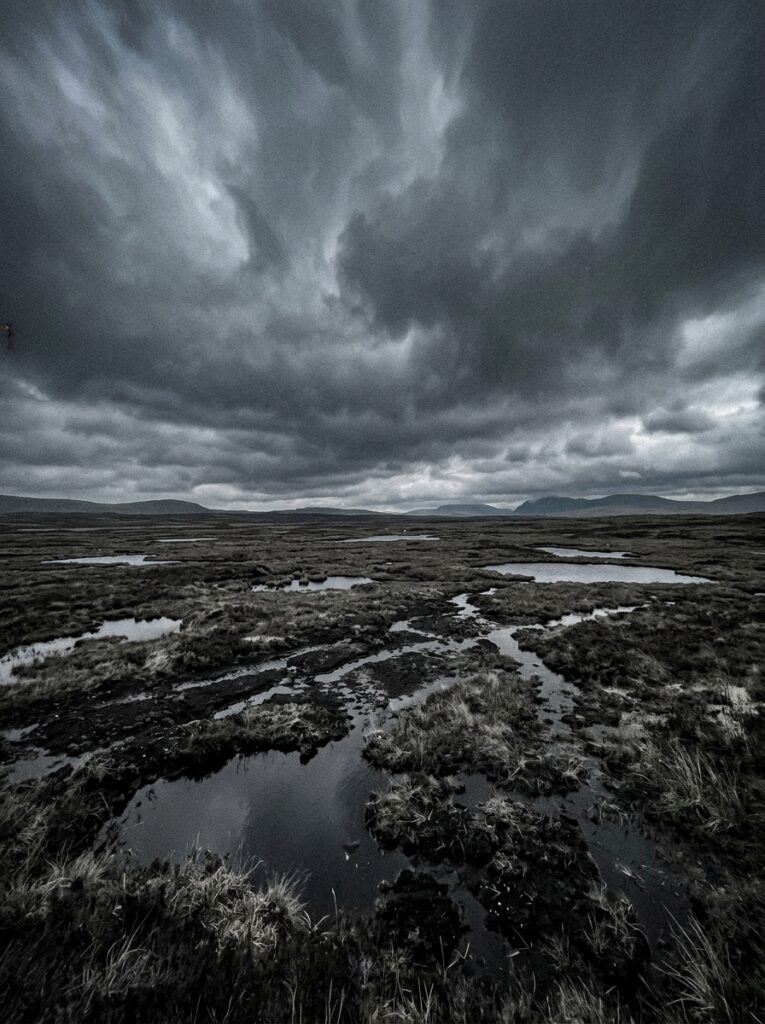
Rannoch Moor Scottish Highlands vast empty peat bog landscape, no trees or structures visible, flat boggy terrain with pools of dark water, enormous overcast sky taking up two thirds of frame
Rannoch Moor is accessible from the A82 south of Glencoe and requires nothing more than walking a short distance from the road to position yourself with no structures or trees in your frame. The entire visual challenge here is giving the sky maximum weight. Walk until the bog and the dark water pools are in your foreground and the horizon is entirely free of any vertical element. Then commit to the sky.
How to Shoot It: Give the sky two thirds of the frame at minimum. A wide angle lens from 16mm to 20mm emphasises the emptiness and the enormous overhead weight of the overcast sky. If you have a graduated ND filter, darken the sky slightly to bring it closer to the tonal weight of the dark bog below. The goal is a composition that feels genuinely, uncomfortably vast.
23. Sea Cliff Edge at Dusk
Moody Scotland photos | Coastal | Cliff | Dusk
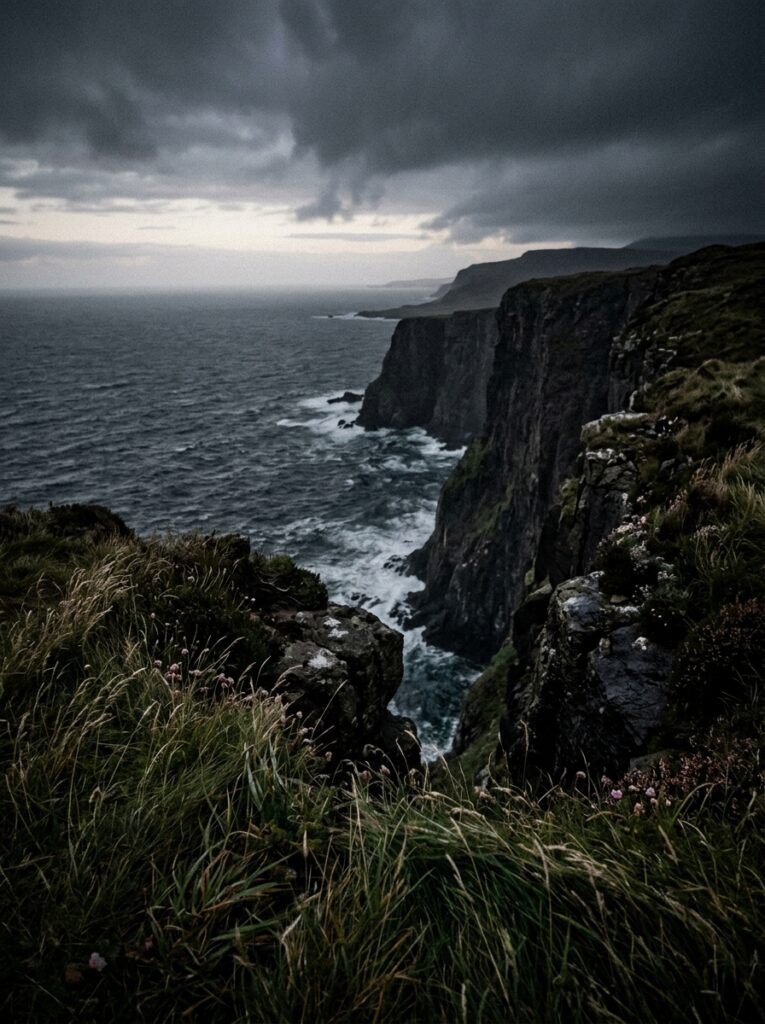
Scottish sea cliff edge at dusk, dark churning Atlantic ocean far below, fading pale grey dusk light on horizon, cliff edge grass in sharp foreground detail, vertiginous drop
The sea cliff edges of Cape Wrath, the Handa Island ferry crossing viewpoints, and the northern Sutherland coast provide the dramatic drops and westward Atlantic views required for this shot. Safety is the primary consideration at any cliff edge in weather conditions. Shoot from a stable, safe position and do not lean over the edge for composition purposes. The vertigo effect in this image comes entirely from focal length and framing, not from dangerous positioning.
How to Shoot It: A wide angle lens from 16mm to 20mm used very close to the cliff edge grass in the foreground creates the vertiginous drop into the dark ocean below. Focus on the foreground grass with a small aperture of f/11 to f/16 for complete depth of field from grass to horizon. Expose for the pale dusk light on the horizon and let the ocean darken naturally.
24. Snow Blizzard on Open Moorland
Dark moody Scotland scenery | Blizzard | Snow | Extreme weather
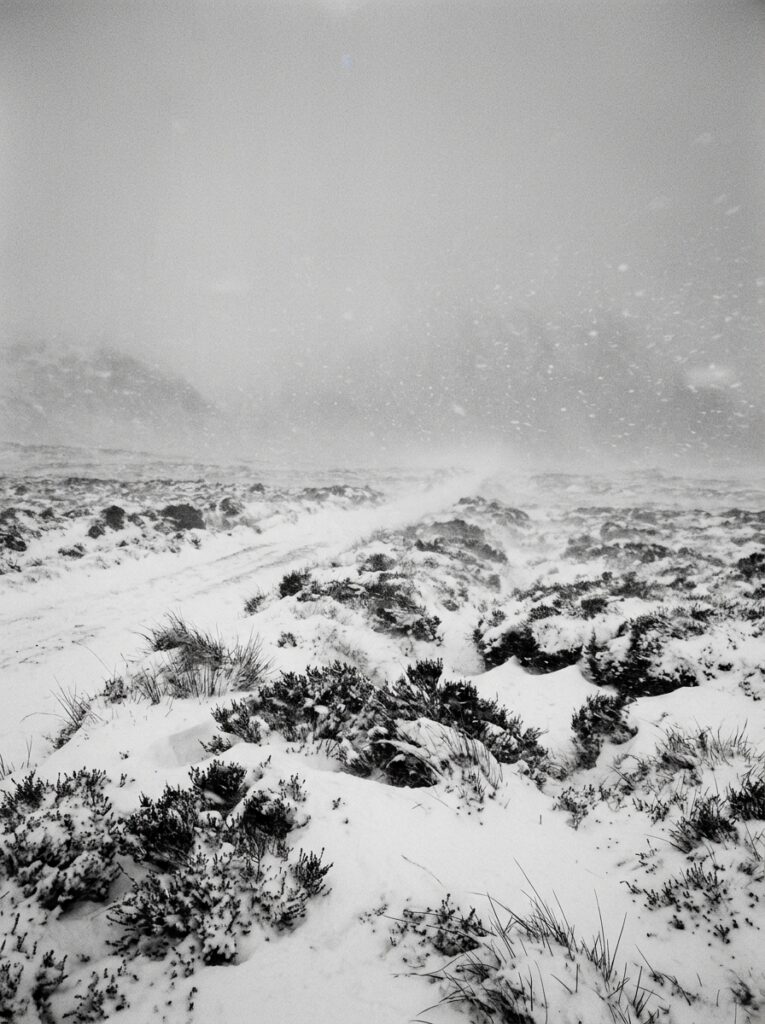
Snow blizzard on open Scottish Highland moorland, thick falling snow obscuring horizon and distance, heather partially buried in fresh snow, wind implied in blowing snow direction, almost monochromatic white grey palette
Shooting in a genuine blizzard is one of the most technically demanding things you can do with a camera and one of the most rewarding when the results come through. Protect your camera with a rain cover or a sealed camera body. Cold temperatures drain batteries faster than usual, so carry at least two fully charged spares in an inside pocket. The image depends on the falling snow being visible and directional, which requires a shutter speed fast enough to render individual snowflakes rather than blur them.
How to Shoot It: A shutter speed of 1/250s or faster freezes the falling snow into visible flakes. Slower speeds blur the snow into streaks, which shows wind direction powerfully but loses the individual flake quality. Expose generously as the white-grey palette of a blizzard scene will push your meter toward underexposure. Review your histogram carefully after each frame.
25. The Last Light on the Loch
Scottish Highlands aesthetic photography | Dusk | Last light | Silhouette
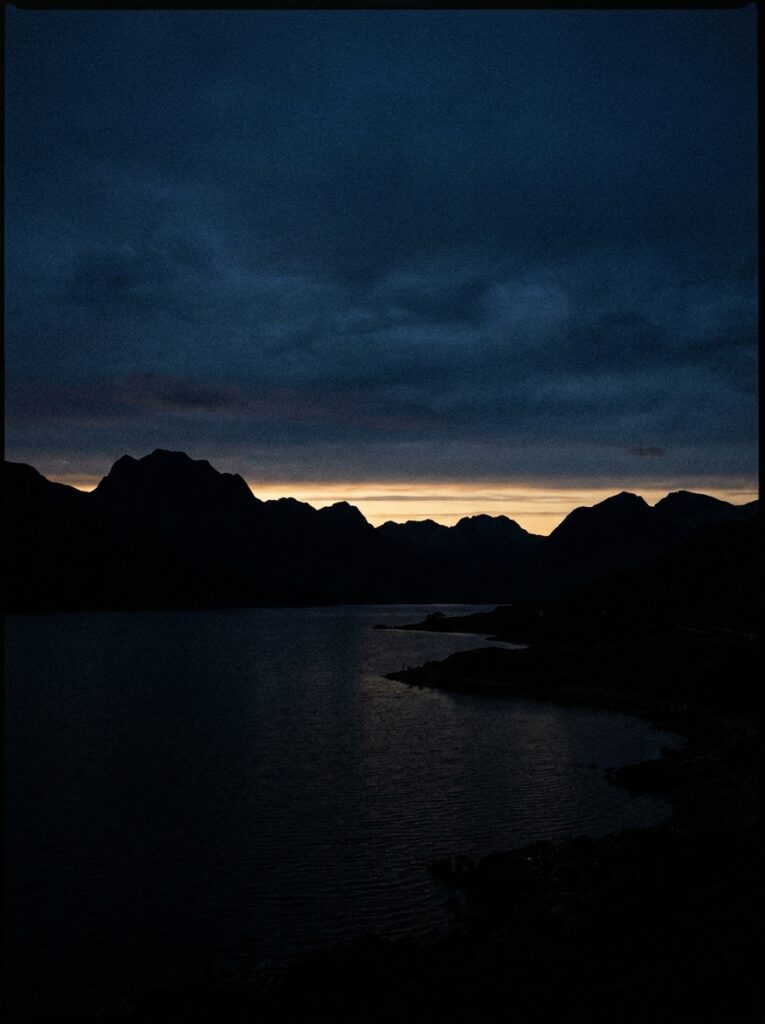
Last light of day over Scottish Highland loch, water surface turning black, mountain ridges becoming dark silhouettes, single thin pale gold line on horizon, deep blue-black sky above
This shot requires you to stay later than you think you need to. Most photographers pack up when the sun sets. The image you are after happens in the fifteen to twenty minutes after the sun is fully below the horizon, when the sky has deepened to blue-black and the only remaining warm light is a thin gold line where the sun went down. The loch will be turning black. The ridges will be silhouettes. This is the moment.
How to Shoot It: You will need ISO 800 to 3200 for this shot without a tripod. With a tripod, use ISO 100 to 400 and an exposure of five to thirty seconds, which will render the black water surface completely smooth and hold that thin gold line with perfect clarity. Compose the horizon line in the lower third of the frame to give maximum weight to the deep blue-black sky above. Do not rush. The last light rewards those who stay.
Field Preparation: What to Bring on a Highland Shoot
The Scottish Highlands can change weather conditions in under an hour. Being unprepared does not mean missing a shot. It means being unable to stay long enough to get it. Here is what consistently makes the difference.
Camera and Lens
A weather-sealed camera body is a significant advantage in Highland conditions. You will be shooting in rain, mist, and sea spray regularly. A 16 to 35mm wide angle zoom covers the landscape and coastal work. A 70 to 200mm telephoto zoom covers wildlife, storm light details, and compressed perspective shots. Bring both if you can.
Tripod
Non-negotiable for waterfall long exposures, dusk shots, blizzard conditions, and any interior ruin work. A carbon fibre tripod is lighter for long walks. Leg spikes rather than rubber feet grip better on wet Highland grass and boggy moorland.
Filters
- Circular polariser: for heather shots, tidal pool reflections, and darkening skies
- Graduated ND filter (3-stop soft edge): for balancing bright skies with dark foregrounds
- Solid ND filter (6 to 10 stop): for long exposure waterfall and loch shots in daylight
Clothing and Safety
Waterproof jacket and trousers. Waterproof boots rated for rough ground. A navigation app with offline maps downloaded before you leave mobile signal range. Tell someone your intended route and expected return time. The Highlands are genuinely remote in many areas and conditions change fast.
Understanding the principles of composition, mood, and visual balance before you head into the field gives you a significant creative advantage. Our beginner’s guide to understanding abstract art is a surprisingly useful read for photographers. The principles of how shapes, tonal relationships, and empty space create emotional responses are identical whether you are working with a brush or a camera.
The Highlands Reward Those Who Show Up
These 25 moody Scotland landscape photos did not happen by accident. They happened because someone was there before the light came, stayed after it went, and knew what to look for in between.
Scottish Highlands aesthetic photography at its best is not about luck. It is about preparation, patience, and the willingness to return to the same location until the conditions deliver what you came for. The Highlands are generous to the persistent. They have more than twenty-five extraordinary scenes. This collection is just the start.
Save the scenes that feel like yours. Study the light. Check the forecast. Set your alarm.
The Highlands will keep. The fog lifts. The last light fades. Go get it.