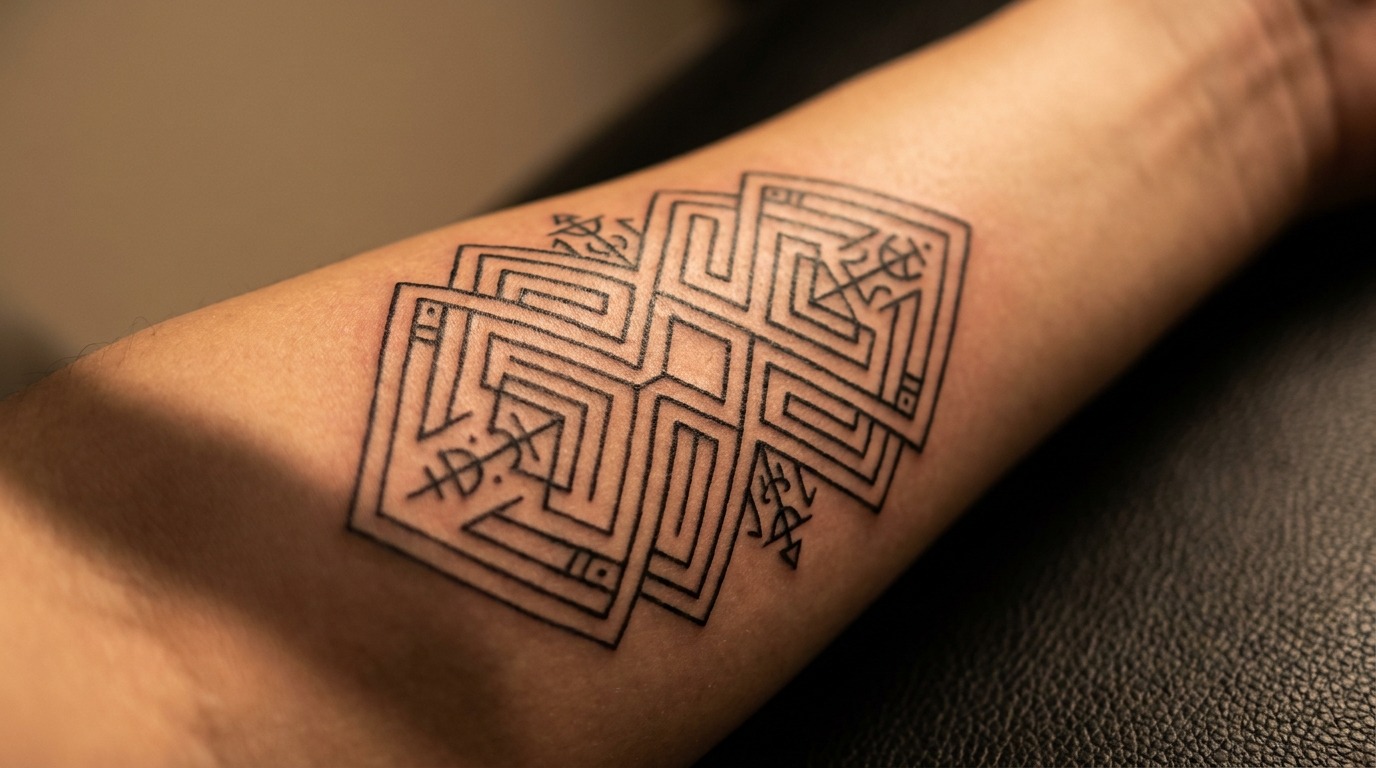
. A cybersigilism tattoo is a contemporary blackwork style built from sharp, flowing linework that reads as part sigil, part circuit board. It doesn’t have one fixed meaning. For some people the design carries something personal. For a lot of people, it’s chosen purely because it looks good on skin, and that’s a legitimate reason on its own.
If you’re trying to decide whether to get one, the meaning question is really only the first of several. Aging, regret, cost, and how to pick the right artist matter just as much. I’ll go through all of it here, honestly, without pretending there’s a single right answer.
What Does a Cybersigilism Tattoo Actually Mean?
There isn’t one universal meaning behind a cybersigilism tattoo, and I’d be skeptical of anyone who tells you otherwise.
The name comes from two ideas mashed together: “cyber,” for digital and futuristic culture, and “sigil,” a symbol traditionally charged with personal or magical intent. That word history is where a lot of the mystique comes from, but it doesn’t mean every design carries a coded message.
In practice, people choose cybersigilism for a handful of reasons:
- A personal symbol built around identity, transformation, or intention, worked out with the artist during design
- A connection to digital culture, gaming, or gothic and Y2K aesthetics
- Pure visual appeal, with no symbolism attached at all
None of these are more “correct” than the others. If you want your design to mean something specific, tell your artist that up front, it’ll shape the whole composition. If you just love how it looks, that’s reason enough too.
What Is Cybersigilism, Visually?
Cybersigilism is defined by thin, precise black linework, sharp angular geometry, and symmetry built around negative space. It emerged around 2020 to 2021 out of Instagram and TikTok, and by the mid-2020s it had become one of the most-searched tattoo styles online.
Visually, it sits somewhere between a glyph and a weapon. Think interlocking spikes, S-curves, and abstract patterns that pull from cyberpunk design, circuit boards, and older tribal tattooing, without belonging to any single cultural tradition. Some artists lean into fine-line work. Others use bolder blackwork or grey wash for more weight.
It’s often compared to 1990s and early-2000s tribal tattoos, and the comparison isn’t wrong. Cybersigilism is best understood as a modern reinterpretation of that same tribal-tattoo impulse, filtered through digital-age aesthetics rather than a specific Indigenous tradition.
Cybersigilism vs. Sigilism vs. Neo-Tribal vs. Ornamental
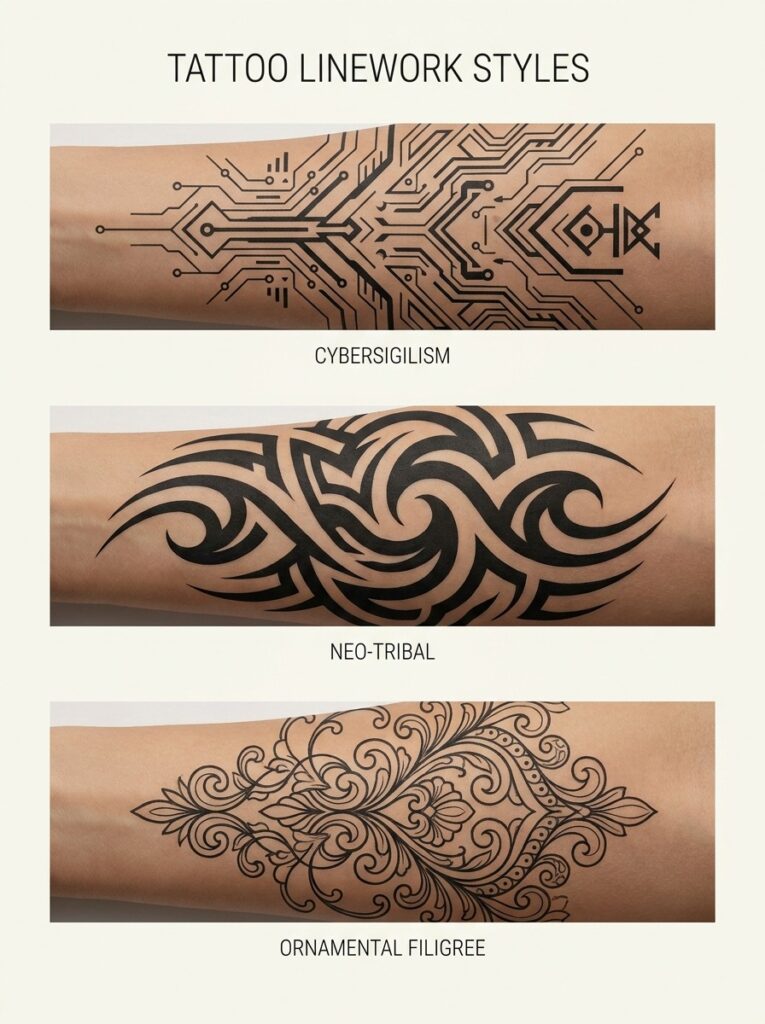
These terms get used interchangeably online, and that’s part of what makes the style confusing to research. Here’s how they actually differ.
| Feature | Sigilism | Cybersigilism | Neo-Tribal | Ornamental |
| Primary focus | Symbol or intention | Digital-looking sigil aesthetic | Modern tribal-inspired flow | Decoration and symmetry |
| Common linework | Variable | Fine or mixed black lines | Often bolder black forms | Fine to bold decorative lines |
| Main influence | Symbolic or magical marks | Cyberpunk, gothic, Y2K, sigils | Tribal revival and body flow | Jewelry, filigree, geometry |
| Typical meaning | Often intentional | Personal, aesthetic, or both | Usually aesthetic or personal | Often decorative or personal |
| Common placement | Small or central symbols | Back, spine, arm, hand, neck | Arms, torso, legs | Sternum, back, shoulders |
Worth saying plainly: these labels overlap, and individual artists classify their own work differently. Don’t treat this table as a strict taxonomy, treat it as a starting vocabulary for a consultation.
Why Do People Dislike Cybersigilism Tattoos?
The criticism is real. Most of it comes from comparing cybersigilism to the tribal-tattoo trend of the 1990s and 2000s, from repetitive online reference designs, from tattoo fans who prefer symbolic work over purely aesthetic pieces, and from real aging concerns around dense, tightly packed fine lines.
It’s worth understanding this before you commit, not after. Some people see it as a repeat of the tribal-tattoo boom from twenty years ago, and worry it’ll age out of style the same way. Others find the online reference designs repetitive, like everyone’s picking from the same small pool of templates. A chunk of the tattoo community simply prefers work with a fixed, legible meaning, and sees purely aesthetic sigil work as hollow. And there’s a genuine technical concern underneath all of it: dense, tightly packed fine lines are harder to keep sharp over decades than bolder, simpler work.
None of that makes cybersigilism a bad choice. It means the criticism is coming from a mix of taste and legitimate technical caution, and you’re allowed to weigh both before deciding it doesn’t apply to you.
Is Cybersigilism Fine Line?
Not always. Fine line is the most common version online because thin linework photographs well, but artists frequently use bolder blackwork or heavier line weight on skin, especially for larger placements or for clients who’d rather prioritize long-term durability over the delicate look.
A lot of the viral reference images use thin, precise linework because it photographs well on a phone screen. On skin, artists frequently mix in bolder blackwork, grey wash, or heavier line weight, especially for larger placements or clients who want the design to hold up better long-term. If aging is a concern for you (and it should be), ask your artist directly whether they’d recommend adjusting the line weight for your specific design and placement. If minimalist linework is more your speed generally, these single-line tattoo ideas are worth a look too, same restraint, a completely different visual language.
Do Cybersigilism Tattoos Age Well?
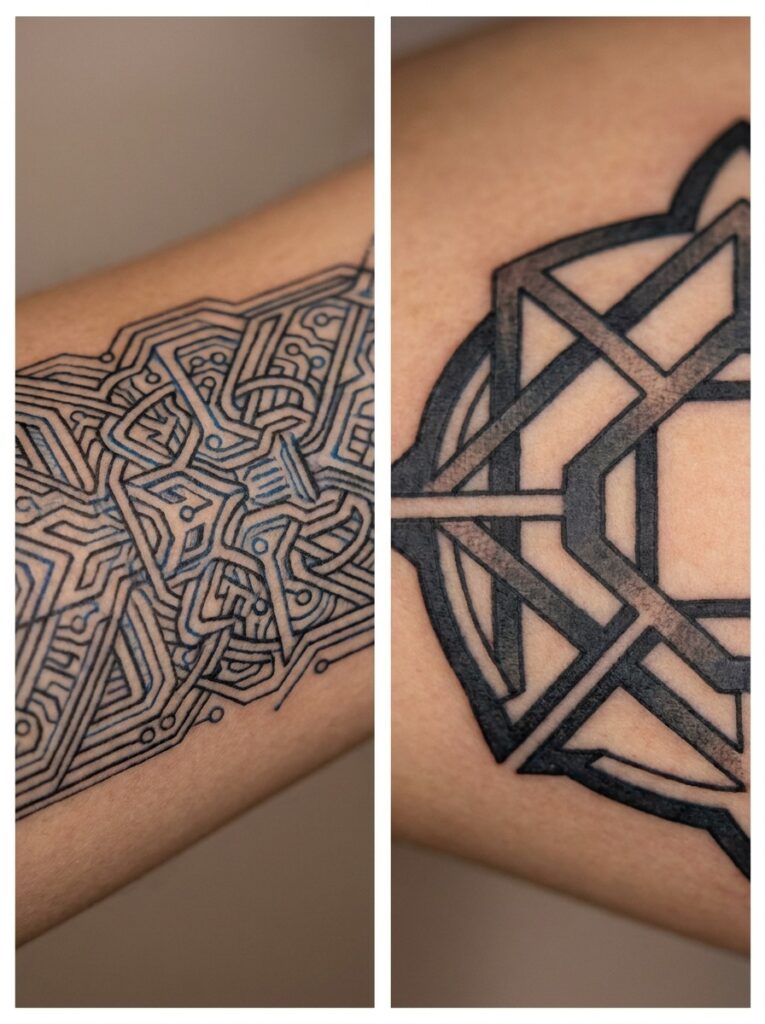
It depends more on execution than on the style itself. Tightly packed fine lines with little negative space are the highest risk for blurring over time, while wider spacing, larger scale, and simpler compositions tend to hold their shape for years longer.
This is the question competitors barely touch, so let’s actually go through it.
Line Weight and Spacing
Thin lines packed close together are the highest-risk combination. As skin ages and ink settles, tight negative space is what tends to close up first, turning crisp detail into a soft dark shape. Wider spacing and slightly heavier line weight both buy you longevity.
Size and Negative Space
Bigger generally ages better here, not because size fixes everything, but because a larger design gives fine details more room to blur without the whole piece reading as muddy. A tiny, densely packed cybersigilism symbol is the version most likely to lose definition within a decade.
Placement and Sun Exposure
Placement matters for two reasons: how much the skin stretches and moves, and how much sun it sees. The American Academy of Dermatology recommends broad-spectrum SPF 30+ on tattoos long-term and flags that UV exposure is one of the main causes of ink fading over time. High-flex areas (hands, fingers, inner wrist) and high-sun areas (forearms, hands, neck) both carry extra aging risk regardless of style.
Fresh vs. Healed Results
Almost every photo you’ll see researching this style is fresh, healed work is much rarer online, largely because it’s less flattering and less shareable. When you’re vetting an artist, ask specifically to see healed photos, not just fresh ones. It’s the single best predictor of how your own piece will hold up.
Is Cybersigilism a Good First Tattoo?
It can be a good first tattoo if you start small. A test placement like a forearm piece, rather than a full back or sleeve, lets you see how you feel about visible ink and how the design ages before committing to something larger and more permanent.
If this is your first tattoo, a small test placement (forearm, or somewhere easily covered) tells you a lot: how you handle the pain, how you feel about it three months later, and whether you actually like living with visible ink. Save the big back piece or full sleeve for once you know that. It’s also worth budgeting properly for a specialist in this style rather than going with whoever’s cheapest or fastest available, the fine detail work genuinely rewards experience.
Will You Regret a Cybersigilism Tattoo?
I can’t answer that for you, and honestly, nobody reliably can. What I can give you is a checklist that tends to separate the people who stay happy from the people who don’t.
- Would you still want this design if it disappeared from your social feeds tomorrow?
- Have you liked the same design, or a close variation of it, for several months, not just this week?
- Are you okay with it marking a specific era of your life, the way any trend-adjacent tattoo eventually does?
- Have you actually seen healed work from the artist you’re considering, not just their fresh photos?
- Does the design leave enough negative space to age cleanly, based on what you now know?
- Will the placement interfere with tattoo plans you might have later?
If you can say yes to most of these, you’re in reasonably good shape. If you’re mostly saying “I think so” to all of them, that’s worth sitting with for a few more weeks before you book.
How Artists Actually Create One
This isn’t something you sketch and tattoo yourself, and a good artist won’t just copy a reference photo directly onto your skin either. Here’s roughly how the process works at a professional level:
- Define the aesthetic and intention. You and the artist talk through what you want the piece to say, if anything, and which reference images actually reflect your taste.
- Choose placement. This comes early, because the design gets built around your specific anatomy, not the other way around.
- Build the composition around the body. A flat digital reference gets redrawn to follow the curve and movement of the actual placement.
- Refine symmetry and negative space. This is where a lot of the aging-resistance decisions happen, spacing gets adjusted for how the piece will hold up over years, not just how it looks on day one.
- Adjust line weight for scale. Smaller designs often need simplification; larger ones can support more detail.
- Stencil or freehand the final plan, then tattoo it.
- Assess the healed result at the follow-up, and plan any touch-ups if needed.
If you want your own design ideas involved, How to Design a Tattoo covers what actually translates from paper or screen to skin, and Is It Rude to Design Your Own Tattoo? is worth a read before you bring a reference image to a consultation.
How to Choose a Cybersigilism Tattoo Artist
Don’t pick based on follower count or price alone. Look for:
- Healed portfolio work, not just fresh photos. Ask directly if they don’t have any posted.
- Specific experience in fine-line or blackwork, not just general tattooing.
- Clean symmetry and long, controlled lines in their existing portfolio.
- A willingness to redraw your reference, rather than tattooing a digital image directly. A screen has sharper contrast than skin, and tiny gaps that look fine on a phone often need to be enlarged or simplified to stay readable once healed.
- A real consultation process, not a five-minute walk-in booking.
- A clear touch-up policy, since dense linework is more likely to need one.
Cybersigilism Tattoo Placement Ideas
Placement shapes both how the design reads and how well it ages. Here’s how the most common placements tend to work for this style.
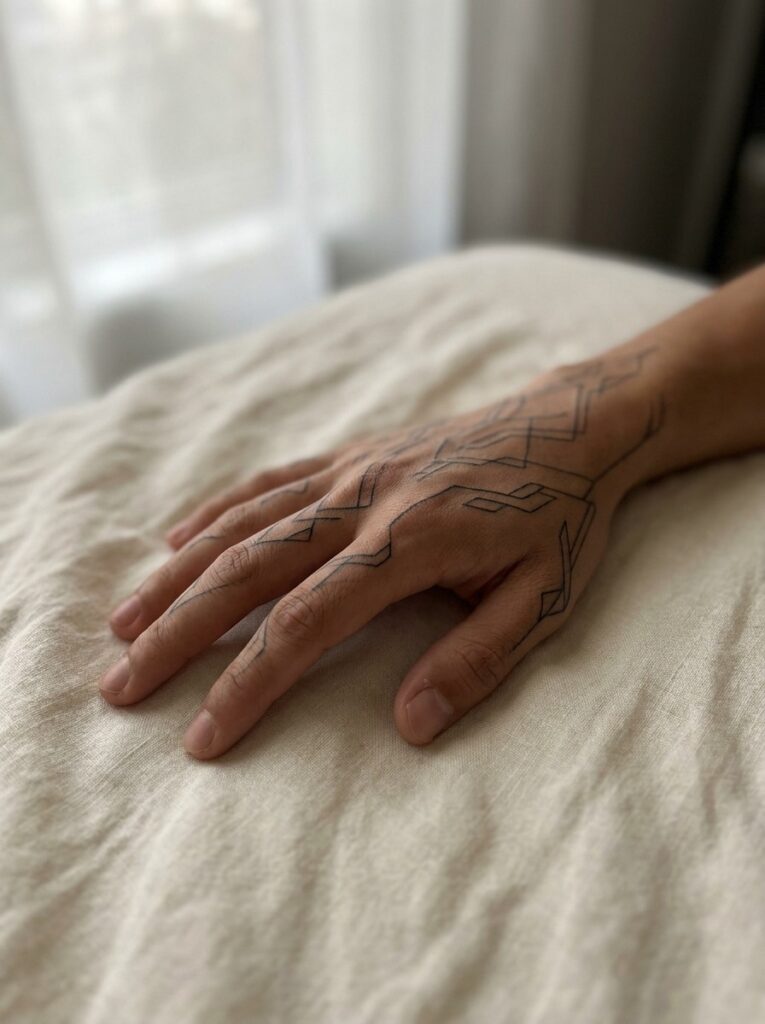
Hand Tattoos
Hands see constant movement and sun, so expect faster fading here than almost anywhere else on the body. Bolder, simpler linework tends to hold up better than dense detail on hands specifically.
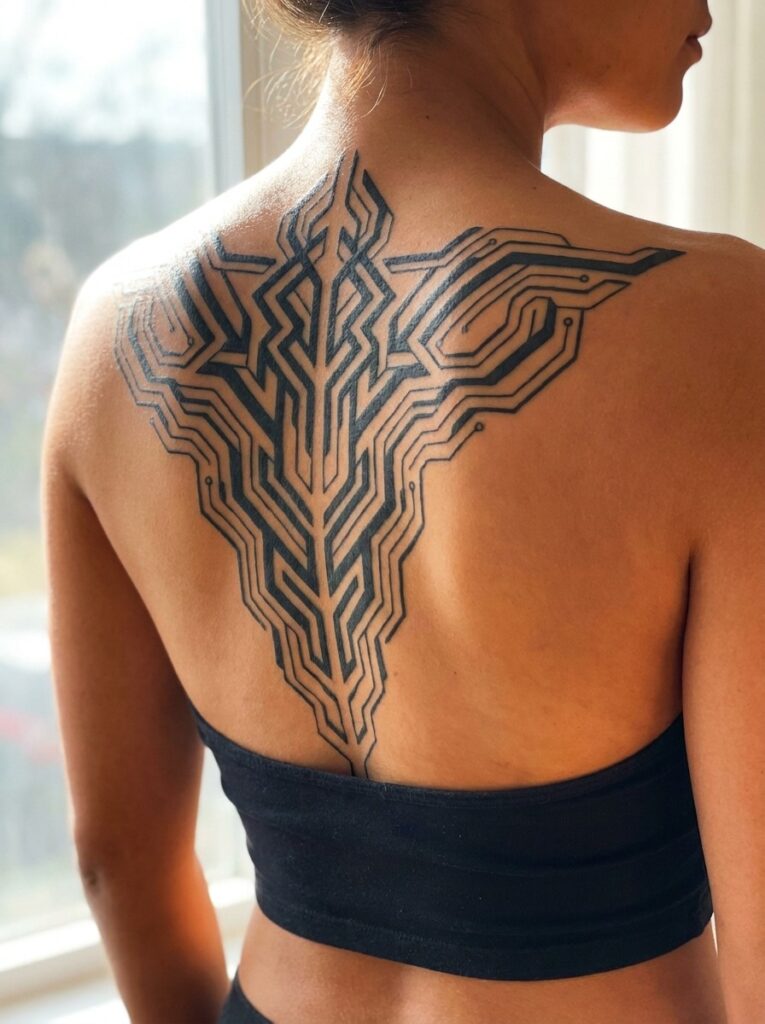
Back and Spine Tattoos
The back and spine give you the most room to work with, which is why a lot of the more elaborate cybersigilism pieces live here. Good body flow along the spine is what separates a piece that looks intentional from one that looks pasted on.
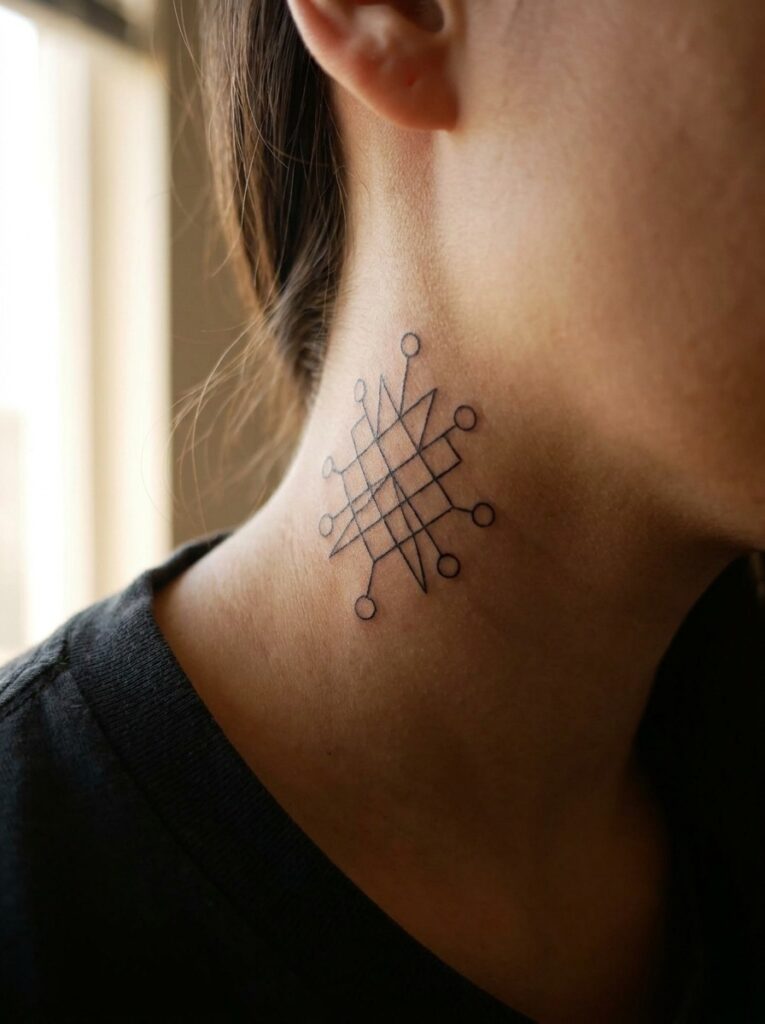
Neck Tattoos
Neck placements are high-visibility and high-commitment. They also see a fair amount of movement and sun, so simpler, well-spaced designs tend to age better than busy, detail-heavy ones here.
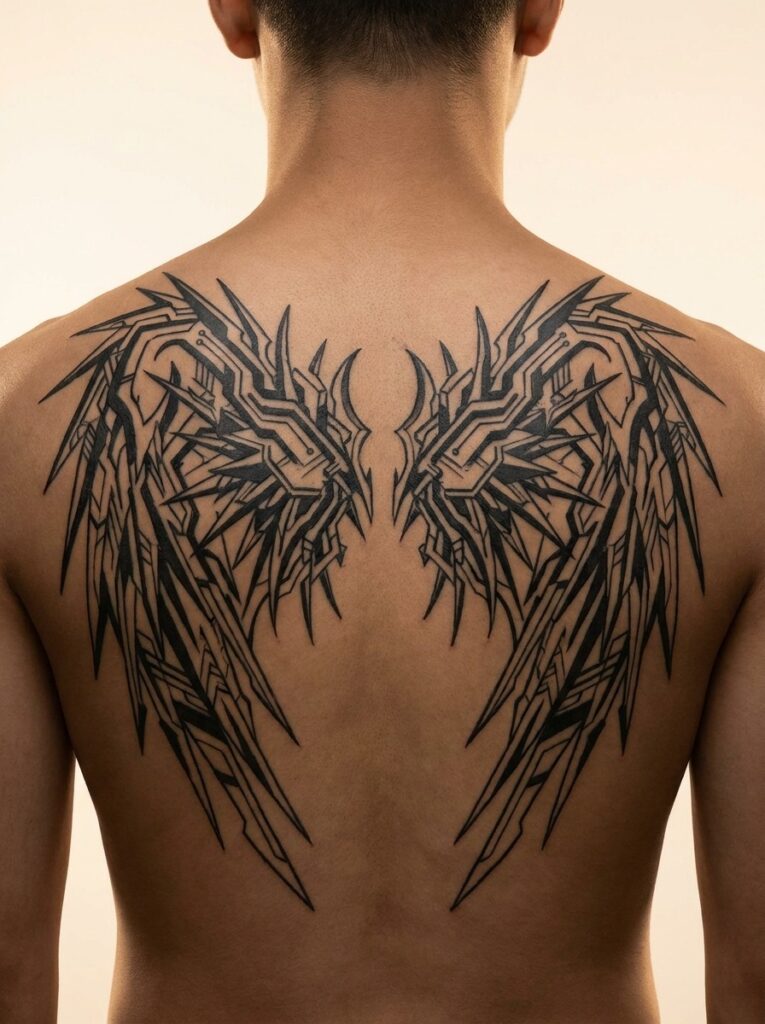
Wing Motifs
Cybersigilism wings, whether shoulder-blade, upper-back, or mechanical in style, are one of the most requested motifs and one of the least written about. Symmetry matters more here than in almost any other placement, since the eye immediately catches an uneven pair.
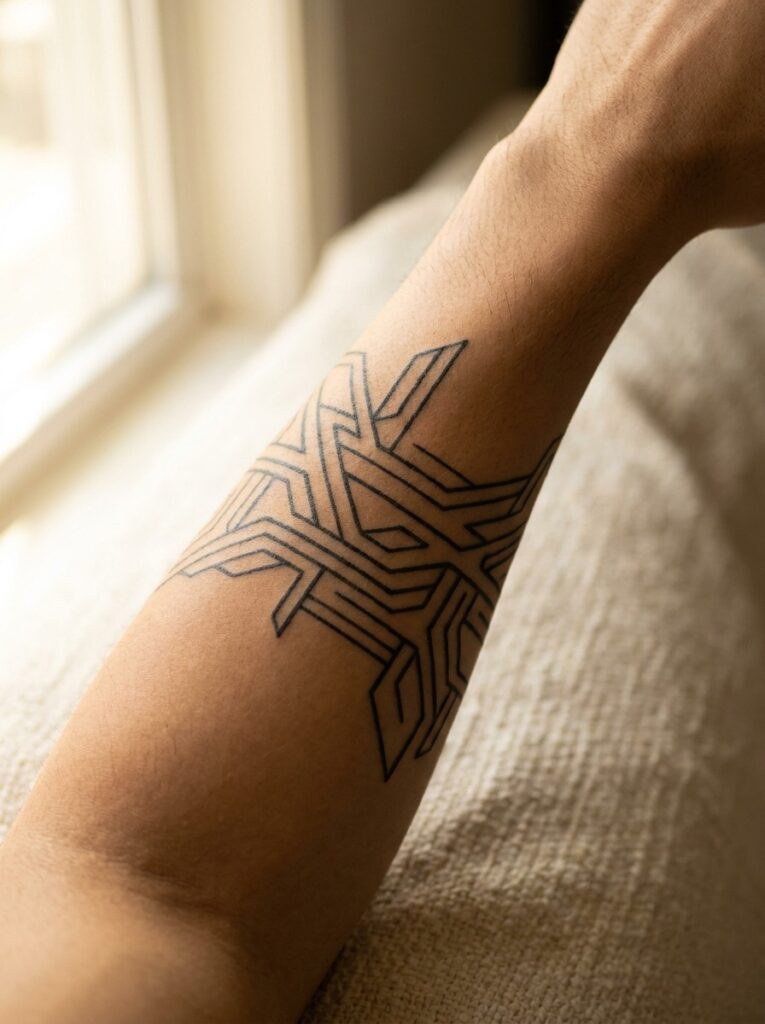
Arm and Forearm Tattoos
Arms and forearms are the most forgiving placement for a first cybersigilism piece: visible when you want it to be, easy to cover for work if needed, and a reasonable size range to start small.
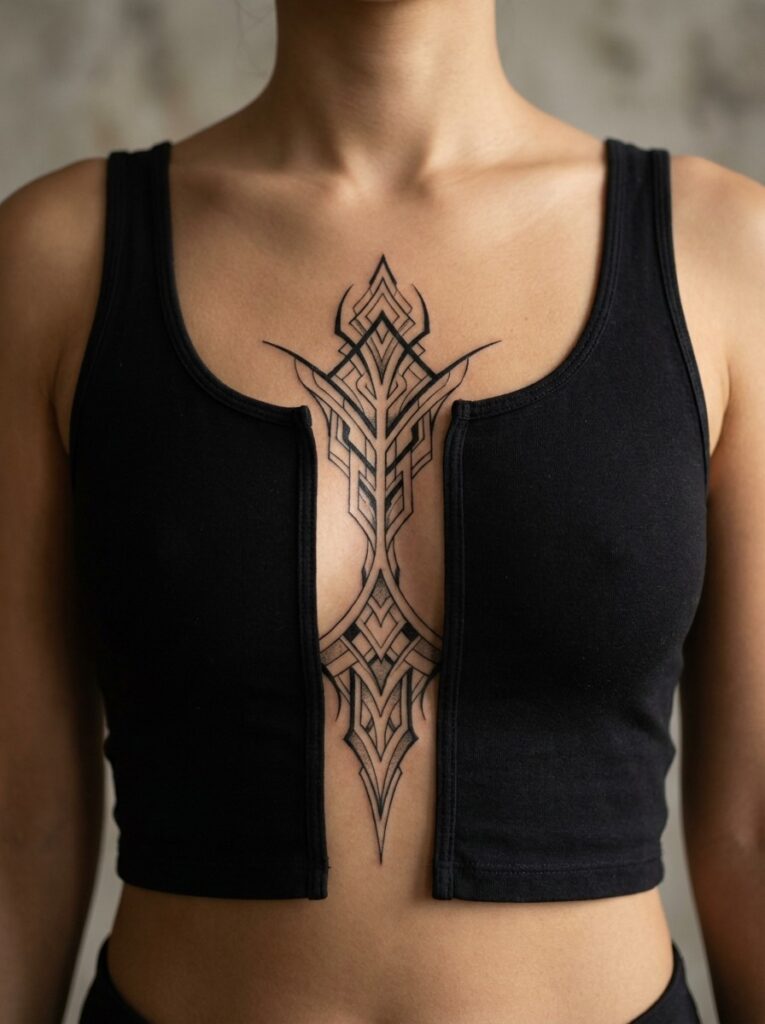
Sternum and Chest Tattoos
Sternum pieces follow the body’s centerline, which makes them a natural fit for the symmetrical compositions this style leans on. They’re also one of the more painful placements, worth factoring into your decision.
How Much Does a Cybersigilism Tattoo Cost?
There’s no honest single number I can give you here, and I’d be wary of any article that does. Cost depends on:
- The artist’s experience and reputation specifically in this style
- Your local market
- Size and placement
- How dense the linework is
- Custom design and drawing time before the session even starts
- Number of sessions needed
- Touch-ups
A small, simple forearm piece from a general artist costs a fraction of a large, custom back piece from a specialist known for this exact style. Ask for a quote during consultation rather than trying to estimate from what you see online.
Can a Cybersigilism Tattoo Be Reworked or Covered?
Often, yes, but it genuinely depends on the specific piece, and this needs an in-person assessment, not a guess from a photo.
Smaller touch-ups and minor rework are usually straightforward. Full cover-ups get more complicated with dark, dense, or large cybersigilism work, since the new design generally needs to be darker and bigger than what it’s covering. For pieces that are too dark or dense to cover directly, laser fading is often used first to lighten the existing ink before a cover-up goes on top. According to the Cleveland Clinic, laser removal works by breaking tattoo ink into smaller particles that your immune system gradually clears, and the number of sessions needed depends on the ink and your own body’s response, which is exactly why a specialist needs to look at your actual tattoo before promising an outcome.
If you’re not sure whether you want to rework, cover, or just sit with it a while longer, that’s a completely reasonable place to be. A consultation costs you nothing but time.
Frequently Asked Questions
Is cybersigilism demonic?
Not inherently. The style can look occult or ritualistic because of its sharp, symbolic linework, but that visual language doesn’t automatically mean the wearer holds any particular belief. Meaning depends entirely on the individual design and the person wearing it.
Is cybersigilism a fad?
It’s trend-driven, which isn’t the same as guaranteed to disappear. Plenty of trend-born styles settle into being simply a style once the initial spike fades. Whether it holds up depends more on your personal attachment to the design than on the trend cycle itself.
Are cybersigilism tattoo references AI-generated?
Some are, some aren’t, and it’s genuinely hard to tell from a screenshot alone. Either way, a good artist redraws the reference to fit your anatomy and translate properly to skin rather than tattooing a digital image as-is.
Do cybersigilism tattoos blur over time?
Dense, tightly packed fine lines are the most likely to soften with age. Wider spacing, appropriate scale for the detail level, and an experienced artist all reduce that risk considerably.
Can a cybersigilism tattoo be small?
Yes, though very small pieces with a lot of packed detail are the highest risk for losing clarity as they age. If you want something small, ask your artist to simplify the design rather than shrinking a complex one down.
The Bottom Line
A cybersigilism tattoo is worth it if you actually love how it looks, not because it’s trending right now. The meaning is whatever you decide to put into it, or nothing at all if that’s genuinely your reason. Spend more time than feels necessary choosing an artist with real healed work to show you, and you’ll avoid most of the regrets people talk about online.